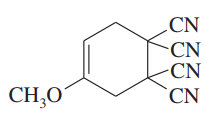
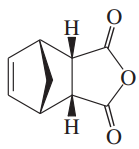
What dienes and dienophiles would react to give the following Diels–Alder products? (d) (e) (f)
Verified step by step guidance
1
Step 1: Analyze the Diels–Alder product structure. The Diels–Alder reaction involves a conjugated diene and a dienophile. The product is a cyclohexene derivative formed by the [4+2] cycloaddition reaction.
Step 2: For the first product (image 1), identify the diene and dienophile. The bicyclic structure with two ester groups suggests that the diene is a conjugated diene (likely 1,3-butadiene) and the dienophile is a molecule with two electron-withdrawing ester groups (likely dimethyl maleate).
Step 3: For the second product (image 2), identify the diene and dienophile. The product contains a methoxy group and four cyano groups. The diene is likely methoxy-substituted 1,3-butadiene, and the dienophile is likely tetracyanoethylene, which has strong electron-withdrawing groups.
Step 4: For the third product (image 3), identify the diene and dienophile. The bicyclic structure with two carbonyl groups and hydrogens suggests that the diene is cyclopentadiene, and the dienophile is maleic anhydride, which has electron-withdrawing carbonyl groups.
Step 5: Summarize the reaction components: (1) 1,3-butadiene + dimethyl maleate, (2) methoxy-substituted 1,3-butadiene + tetracyanoethylene, (3) cyclopentadiene + maleic anhydride. These combinations lead to the respective Diels–Alder products shown in the images.
Verified video answer for a similar problem:
This video solution was recommended by our tutors as helpful for the problem above
Video duration:
7m
Play a video:
0 Comments
Key Concepts
Here are the essential concepts you must grasp in order to answer the question correctly.
Diels–Alder Reaction
The Diels–Alder reaction is a [4+2] cycloaddition reaction between a conjugated diene and a dienophile, resulting in the formation of a six-membered ring. This reaction is a key method in organic synthesis for constructing cyclic compounds and is characterized by its stereospecificity and regioselectivity. Understanding the reactivity of dienes and dienophiles is crucial for predicting the products formed in this reaction.
Dienes are compounds that contain two double bonds, which can be conjugated or isolated, while dienophiles are typically alkenes or alkynes that react with dienes. The nature of the substituents on these molecules influences their reactivity and the stereochemistry of the resulting Diels–Alder product. Identifying suitable dienes and dienophiles is essential for successfully predicting the products of the reaction.
Functional groups are specific groups of atoms within molecules that are responsible for the characteristic chemical reactions of those molecules. In the context of the Diels–Alder reaction, the presence of electron-withdrawing or electron-donating groups on the dienophile can significantly affect its reactivity with the diene. Recognizing and understanding these functional groups is vital for analyzing the structures of the Diels–Alder products and predicting their formation.

 7:24 minutes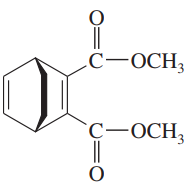
 Verified step by step guidance
 04:02
04:02