
Ch. 6 - The Reactions of Alkenes • The Stereochemistry of Addition Reactions
Bruice - Organic Chemistry 8th Edition
Bruice8th EditionOrganic ChemistryISBN: 9780135213711Not the one you use?Change textbook
Chapter 7, Problem 70a,b(7)

a. Draw the product or products that will be obtained from the reaction of cis-2-butene and trans-2-butene with each of the following reagents. If a product can exist as stereoisomers, show which stereoisomers are formed.
7. H2O + H2SO4
b. With which reagents do the two alkenes react to form different products?

Verified step by step guidance
1
Step 1: Understand the reaction mechanism. The addition of H2O in the presence of H2SO4 follows the acid-catalyzed hydration mechanism. This involves the formation of a carbocation intermediate, followed by nucleophilic attack by water and subsequent deprotonation to yield the alcohol product.
Step 2: Analyze the structure of cis-2-butene and trans-2-butene. Both are alkenes with the same molecular formula (C4H8) but differ in their stereochemistry. Cis-2-butene has both methyl groups on the same side of the double bond, while trans-2-butene has methyl groups on opposite sides.
Step 3: Predict the product formation. The reaction will yield 2-butanol as the major product for both cis-2-butene and trans-2-butene. Since the reaction proceeds through a planar carbocation intermediate, the stereochemistry of the starting alkene does not influence the stereochemistry of the product. The product will not exhibit stereoisomerism.
Step 4: Address part b of the problem. The two alkenes (cis-2-butene and trans-2-butene) react with H2O + H2SO4 to form the same product (2-butanol). To determine reagents that yield different products, consider reactions where stereochemistry plays a role, such as catalytic hydrogenation or halogen addition.
Step 5: Conclude the analysis. For part b, cis-2-butene and trans-2-butene react differently with reagents like Br2 (bromine addition) or H2 (catalytic hydrogenation), as these reactions preserve or influence stereochemistry, leading to distinct products or stereoisomers.

Verified video answer for a similar problem:

This video solution was recommended by our tutors as helpful for the problem above.
Video duration:
6m
Was this helpful?

Key Concepts

Here are the essential concepts you must grasp in order to answer the question correctly.

Alkene Reactivity

Alkenes are unsaturated hydrocarbons characterized by at least one carbon-carbon double bond. Their reactivity is primarily due to this double bond, which can undergo various addition reactions. Understanding how alkenes react with electrophiles, such as water in the presence of an acid catalyst, is crucial for predicting the products formed in these reactions.
Recommended video:
2:09
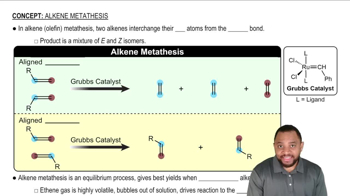
Alkene Metathesis Concept 1

Markovnikov's Rule

Markovnikov's Rule states that in the addition of HX to an alkene, the hydrogen atom will attach to the carbon with the greater number of hydrogen atoms already attached. This principle helps predict the regioselectivity of reactions involving alkenes, such as the hydration of cis-2-butene and trans-2-butene, leading to different products based on the structure of the starting material.
Recommended video:
Guided course
03:54
The 18 and 16 Electron Rule

Stereoisomerism

Stereoisomerism occurs when compounds have the same molecular formula and connectivity but differ in the spatial arrangement of atoms. In the context of alkenes, cis and trans isomers arise from restricted rotation around the double bond. When alkenes react with reagents like H2O in acid, the formation of stereoisomers can occur, necessitating an understanding of how these isomers are generated and represented.
Recommended video:
Guided course
01:58
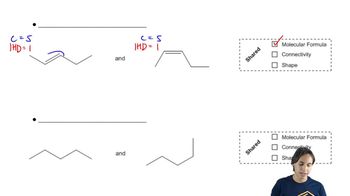
Determining when molecules are stereoisomers.
Related Practice
Textbook Question

Draw the product or products that will be obtained from the reaction of cis-2-butene and trans-2-butene with each of the following reagents. If a product can exist as stereoisomers, show which stereoisomers are formed.

3. a peroxyacid

1260
views
Textbook Question

Draw the product or products that will be obtained from the reaction of cis-2-butene and trans-2-butene with each of the following reagents. If a product can exist as stereoisomers, show which stereoisomers are formed.

4. Br2 in CH2Cl2

687
views
Textbook Question

Draw the product or products that will be obtained from the reaction of cis-2-butene and trans-2-butene with each of the following reagents. If a product can exist as stereoisomers, show which stereoisomers are formed.

1. HCl

857
views
Textbook Question

The second-order rate constant (in units of M-1s-1) for acid-catalyzed hydration at 25 °C is given for each of the following alkenes:

a. Calculate the relative rates of hydration of the alkenes. (Hint: Divide each rate constant by the smallest rate constant of the series: 3.51 × 10⁻⁸.)

b. Why does (Z)-2-butene react faster than (E)-2-butene?

c. Why does 2-methyl-2-butene react faster than (Z)-2-butene?

d. Why does 2,3-dimethyl-2-butene react faster than 2-methyl-2-butene?

1621
views
Textbook Question

1-Methylcyclohexene forms two products when it reacts with bromine in methanol.

a. Draw the mechanism for the formation of the products.

b. Describe their stereochemical relationship—that is, are they enantiomers or diastereomers?

2019
views
Textbook Question

Draw the products of the following reactions. If the products can exist as stereoisomers, show which stereoisomers are formed.

b.

2203
views