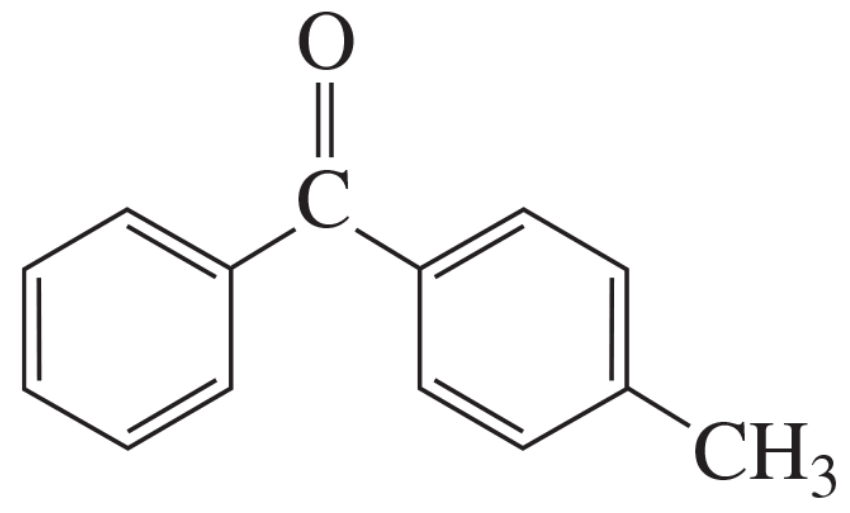
Show two pairs of reagents that would each result in formation of the following compound:
Verified step by step guidance
1
Step 1: Analyze the target compound. The structure contains a ketone group (C=O) attached to two aromatic rings: one is a benzene ring, and the other is a methyl-substituted benzene ring (toluene). This suggests the compound can be synthesized via a Friedel-Crafts acylation reaction.
Step 2: Identify the acyl group. The ketone group indicates the presence of a benzoyl group (C6H5CO-) attached to the methyl-substituted benzene ring. This implies that the acylating agent could be benzoyl chloride (C6H5COCl).
Step 3: Pair 1 of reagents: Use benzoyl chloride (C6H5COCl) as the acylating agent and methylbenzene (toluene, C6H5CH3) as the aromatic substrate. Combine these reagents in the presence of a Lewis acid catalyst, such as aluminum chloride (AlCl3), to facilitate the Friedel-Crafts acylation reaction.
Step 4: Pair 2 of reagents: Alternatively, use benzoic acid (C6H5COOH) as the acylating agent and methylbenzene (toluene, C6H5CH3) as the aromatic substrate. In this case, the reaction can be carried out using a dehydrating agent like phosphorus pentoxide (P2O5) or thionyl chloride (SOCl2) to convert the benzoic acid into an acylating intermediate.
Step 5: Ensure reaction conditions are optimized. For both pairs of reagents, maintain anhydrous conditions to prevent side reactions. Monitor the reaction progress using techniques like thin-layer chromatography (TLC) to confirm the formation of the desired ketone product.
Verified video answer for a similar problem:
This video solution was recommended by our tutors as helpful for the problem above
Video duration:
5m
Play a video:
0 Comments
Key Concepts
Here are the essential concepts you must grasp in order to answer the question correctly.
Reagents in Organic Synthesis
Reagents are substances that participate in a chemical reaction to form new products. In organic synthesis, selecting the right reagents is crucial for achieving the desired transformation. Understanding the reactivity and compatibility of different reagents allows chemists to design effective synthetic pathways to create specific compounds.
Synthesis of Amino Acids: Strecker Synthesis Example 1
Functional Groups
Functional groups are specific groups of atoms within molecules that are responsible for the characteristic chemical reactions of those molecules. Identifying the functional groups present in the target compound is essential for determining which reagents can be used to synthesize it. This knowledge helps in predicting the reactivity and interactions of the compound during the synthesis process.
A reaction mechanism is a step-by-step description of how a chemical reaction occurs, detailing the bond-breaking and bond-forming processes. Understanding reaction mechanisms is vital for predicting the outcomes of reactions and for designing synthetic routes. By analyzing mechanisms, chemists can identify alternative reagents that may lead to the same product through different pathways.