Draw the product(s) of each of the following reactions: c. p-xylene + acetyl chloride + AlCl3 followed by H2O
Verified step by step guidance
1
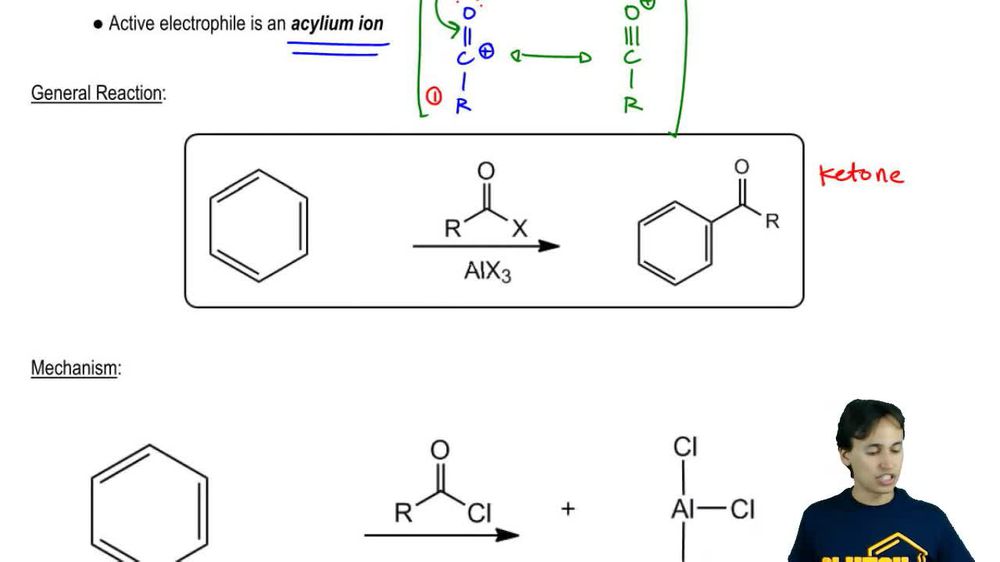
Step 1: For part (c), recognize that the reaction involves Friedel-Crafts acylation. This reaction uses acetyl chloride (CH3COCl) and AlCl3 as a Lewis acid catalyst to introduce an acyl group (-COCH3) onto an aromatic ring. p-Xylene (1,4-dimethylbenzene) is the aromatic compound in this case.
Step 2: Identify the positions on the aromatic ring where substitution is likely to occur. The methyl groups on p-xylene are electron-donating groups, which activate the aromatic ring and direct substitution to the ortho and para positions relative to themselves. Since the para position is already occupied, the acyl group will be introduced at one of the ortho positions relative to a methyl group.
Step 3: Write the intermediate formed after the acylation step. The acyl group attaches to one of the ortho positions, and the AlCl3 catalyst temporarily forms a complex with the aromatic ring. After hydrolysis (H2O step), the catalyst is regenerated, and the final product is obtained.
Step 4: For part (d), recognize that the reaction involves electrophilic aromatic substitution between o-methylaniline (an aromatic amine with a methyl group ortho to the amino group) and benzenediazonium chloride (C6H5N2+Cl−). This is an example of an azo coupling reaction, which forms an azo compound (-N=N-).
Step 5: Determine the site of coupling on o-methylaniline. The amino group (-NH2) is an electron-donating group, activating the aromatic ring and directing substitution to the ortho and para positions relative to itself. Since the ortho position is already occupied by a methyl group, the coupling occurs at the para position. The product is an azo compound where the diazonium group (-N=N-) is attached to the para position of o-methylaniline.
Verified video answer for a similar problem:
This video solution was recommended by our tutors as helpful for the problem above
Video duration:
3m
Play a video:
0 Comments
Key Concepts
Here are the essential concepts you must grasp in order to answer the question correctly.
Friedel-Crafts Acylation
Friedel-Crafts acylation is a reaction that introduces an acyl group into an aromatic ring using an acyl chloride and a Lewis acid catalyst, such as AlCl3. In this process, the aromatic compound (like p-xylene) reacts with the acyl chloride to form a ketone, which retains the aromaticity of the ring. The reaction is important for synthesizing aromatic ketones and understanding electrophilic aromatic substitution.
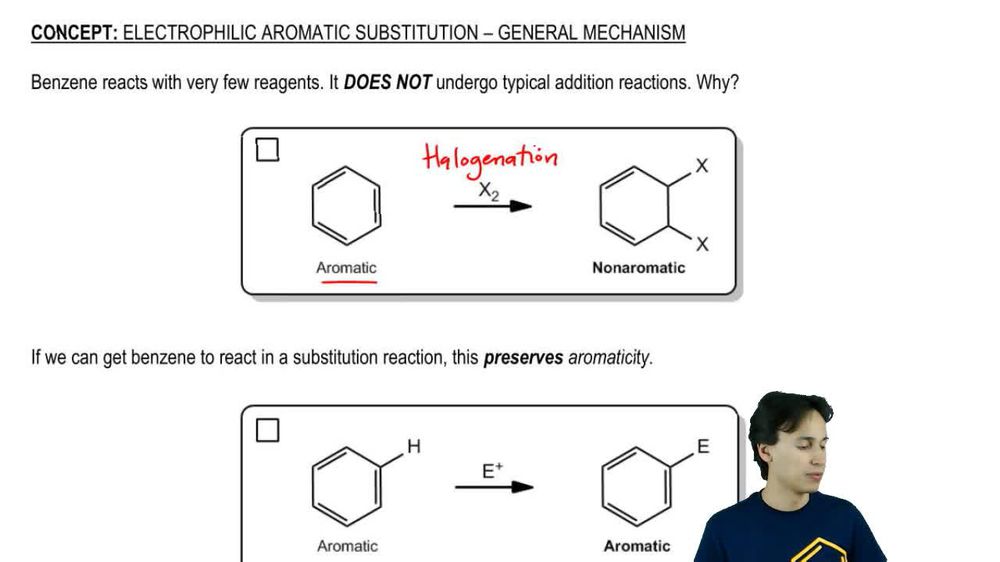
Electrophilic aromatic substitution (EAS) is a fundamental reaction mechanism in organic chemistry where an electrophile replaces a hydrogen atom on an aromatic ring. This process preserves the aromaticity of the compound and is crucial for modifying aromatic systems. The nature of the substituents on the ring can influence the reactivity and orientation of the substitution, making it essential to consider when predicting products.
Diazonium salts are highly reactive intermediates formed from primary aromatic amines and nitrous acid. They are key in various coupling reactions, particularly in the synthesis of azo compounds. In the presence of nucleophiles, such as phenols or other aromatic compounds, diazonium salts can undergo electrophilic substitution, leading to the formation of colored azo dyes, which are significant in both organic synthesis and industrial applications.