Predict the major products formed when benzene reacts (just once) with the following reagents. (k) carbon monoxide, HCl, and AlCl3/CuCl (l) CH2(COCl)2, AlCl3
Verified step by step guidance
1
Step 1: Recognize the type of reaction involved. Both reactions involve electrophilic aromatic substitution (EAS), where benzene reacts with an electrophile to form a substituted benzene derivative.
Step 2: For reaction (k), identify the reagents: carbon monoxide (CO), HCl, and AlCl3/CuCl. This combination is used in the Gattermann-Koch reaction, which introduces a formyl group (-CHO) onto the benzene ring. The electrophile generated in this reaction is the formyl cation (HCO⁺).
Step 3: In the Gattermann-Koch reaction, the formyl cation (HCO⁺) is generated by the reaction of CO and HCl in the presence of AlCl3 and CuCl. This electrophile then reacts with benzene to form benzaldehyde (C6H5CHO) as the major product.
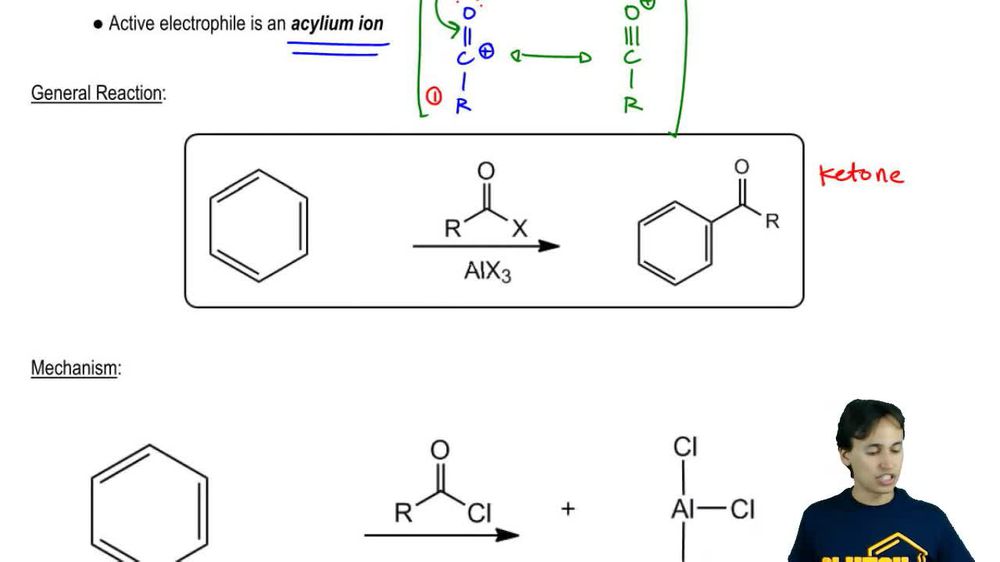
Step 4: For reaction (l), identify the reagents: CH2(COCl)2 and AlCl3. This combination is used in a Friedel-Crafts acylation reaction. The reagent CH2(COCl)2 is malonyl chloride, and in the presence of AlCl3, it generates an acylium ion (CH(CO)⁺) as the electrophile.
Step 5: In the Friedel-Crafts acylation reaction, the acylium ion (CH(CO)⁺) reacts with benzene to form a substituted benzene derivative. The major product is benzene with a CH(CO) group attached, specifically phenylacetyl chloride (C6H5CH(CO)Cl).
Verified video answer for a similar problem:
This video solution was recommended by our tutors as helpful for the problem above
Video duration:
5m
Play a video:
0 Comments
Key Concepts
Here are the essential concepts you must grasp in order to answer the question correctly.
Electrophilic Aromatic Substitution
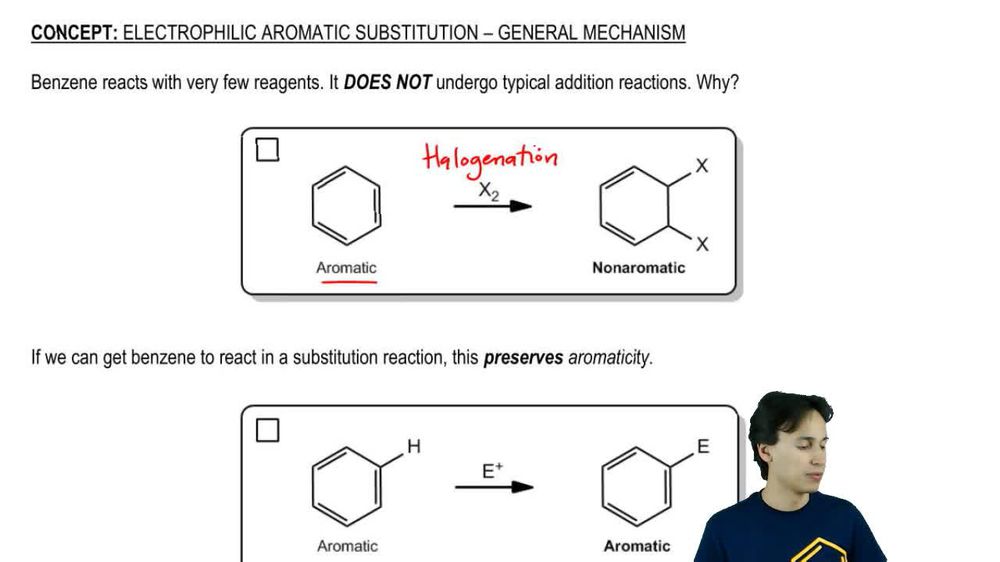
Electrophilic aromatic substitution (EAS) is a fundamental reaction mechanism in organic chemistry where an electrophile replaces a hydrogen atom on an aromatic ring. This process is crucial for understanding how benzene and its derivatives react with various reagents, leading to the formation of substituted aromatic compounds. The stability of the aromatic system is maintained during the reaction, making EAS a key concept in predicting the products of reactions involving benzene.
Friedel-Crafts acylation is a specific type of electrophilic aromatic substitution that introduces an acyl group into an aromatic ring. This reaction typically involves the use of an acyl chloride and a Lewis acid catalyst, such as AlCl3, to generate the acylium ion, which acts as the electrophile. Understanding this mechanism is essential for predicting the products when benzene reacts with acylating agents like CH2(COCl)2.
The reactivity of electrophiles is a critical concept in organic chemistry, as it determines how readily a given electrophile will react with an aromatic compound. Factors such as the electrophile's charge, size, and the presence of electron-withdrawing or donating groups influence its strength and ability to attack the electron-rich aromatic ring. In the context of the question, understanding the nature of the electrophiles generated from the reagents is vital for predicting the major products formed in the reactions.

 5:30 minutes
 Verified step by step guidance
 03:07
03:07