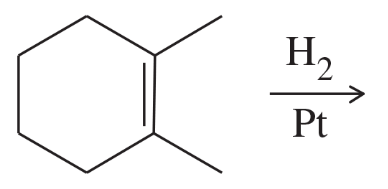
Predict the major products of the following reactions, and give the structures of any intermediates. Include stereochemistry where appropriate. (m)
Verified step by step guidance
1
Step 1: Identify the type of reaction. The reaction involves hydrogen gas (H₂) and a platinum (Pt) catalyst, which indicates a catalytic hydrogenation reaction. This type of reaction typically reduces double bonds (alkenes) to single bonds (alkanes).
Step 2: Analyze the structure of the reactant. The reactant is a cyclohexene derivative with one double bond in the ring and a methyl group attached to the ring. The double bond is the site of reactivity in this reaction.
Step 3: Predict the intermediate. In catalytic hydrogenation, there are no long-lived intermediates. The double bond interacts with the catalyst surface, allowing hydrogen atoms to add across the double bond in a syn addition manner.
Step 4: Determine the major product. The double bond in the cyclohexene ring will be fully reduced to a single bond, resulting in a cyclohexane ring. The methyl group remains attached to the same position on the ring.
Step 5: Consider stereochemistry. Since the addition of hydrogen occurs on the same face of the double bond (syn addition), stereochemistry is not a concern here because the product is a saturated ring (cyclohexane), which does not have stereochemical centers.
Verified video answer for a similar problem:
This video solution was recommended by our tutors as helpful for the problem above
Video duration:
2m
Play a video:
0 Comments
Key Concepts
Here are the essential concepts you must grasp in order to answer the question correctly.
Hydrogenation
Hydrogenation is a chemical reaction that involves the addition of hydrogen (H2) to an unsaturated compound, typically alkenes or alkynes, to convert them into saturated hydrocarbons. This process is often facilitated by a catalyst, such as platinum (Pt), palladium (Pd), or nickel (Ni). In the context of the provided reaction, hydrogenation will convert the double bond in the aromatic compound into a single bond, resulting in a saturated product.
Stereochemistry refers to the study of the spatial arrangement of atoms in molecules and how this affects their chemical behavior. In reactions involving double bonds, such as hydrogenation, the stereochemistry of the product can be significant, as it may lead to different isomers. Understanding stereochemistry is crucial for predicting the major products and their configurations, especially when chiral centers are formed or affected during the reaction.
A reaction mechanism is a step-by-step description of the process by which reactants are converted into products. It outlines the sequence of elementary steps, including the formation of intermediates and transition states. In the case of hydrogenation, the mechanism involves the adsorption of hydrogen onto the catalyst surface, followed by the transfer of hydrogen atoms to the unsaturated compound, leading to the formation of the final saturated product. Understanding the mechanism helps in predicting the products and intermediates involved.