What product results when the following molecules are treated with H₂ Pd/C? Be sure to indicate the relative stereochemical outcome. Draw both enantiomers of any racemic mixtures. [It is difficult to control the stoichiometry of gases so there is enough H₂ to reduce all alkenes.] (b)
Verified step by step guidance
1
Identify the functional groups present in the molecule. In this case, look for alkenes, which are carbon-carbon double bonds.
Understand the role of the reagents: H₂ and Pd/C. This combination is used for catalytic hydrogenation, which typically reduces alkenes to alkanes by adding hydrogen across the double bond.
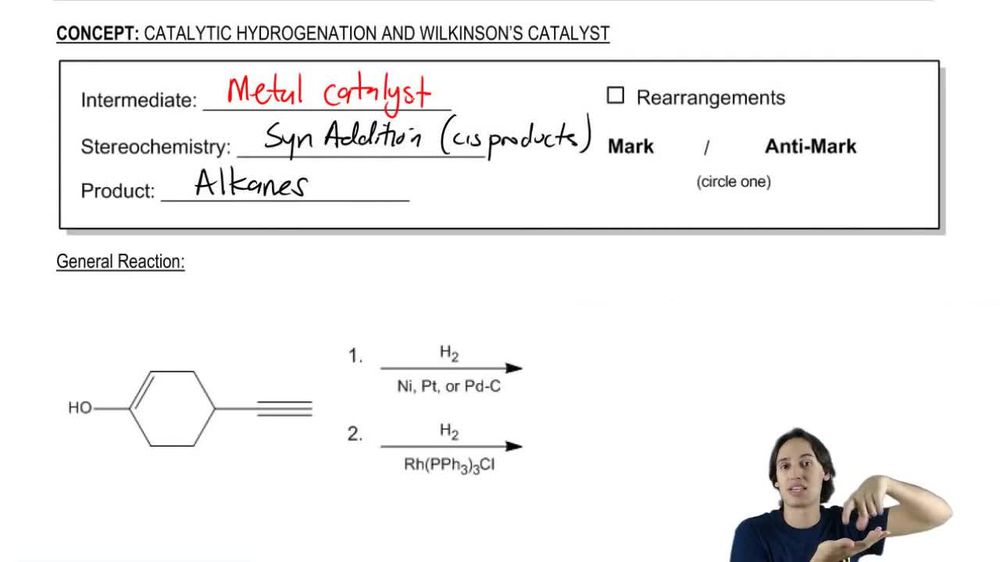
Consider the stereochemistry of the reaction. Hydrogenation with H₂ Pd/C generally leads to syn addition, meaning both hydrogen atoms add to the same face of the double bond, resulting in a specific stereochemical outcome.
Determine if the molecule has any chiral centers after the hydrogenation. If new chiral centers are formed, consider the possibility of forming enantiomers, which are non-superimposable mirror images.
Draw the product(s) of the reaction, ensuring to represent both enantiomers if a racemic mixture is formed. Indicate the stereochemistry clearly using wedge and dash bonds to show the three-dimensional arrangement of atoms.
Verified video answer for a similar problem:
This video solution was recommended by our tutors as helpful for the problem above
Video duration:
4m
Play a video:
0 Comments
Key Concepts
Here are the essential concepts you must grasp in order to answer the question correctly.
Catalytic Hydrogenation
Catalytic hydrogenation is a chemical reaction where hydrogen (H₂) is added to unsaturated bonds, such as alkenes, in the presence of a catalyst like palladium on carbon (Pd/C). This process converts alkenes into alkanes by breaking the double bonds and saturating them with hydrogen atoms. The reaction typically proceeds with syn addition, meaning both hydrogen atoms add to the same side of the double bond, affecting the stereochemistry of the product.
Stereochemistry refers to the spatial arrangement of atoms in molecules and its impact on chemical reactions. In hydrogenation, the syn addition of hydrogen atoms can lead to specific stereochemical outcomes, such as the formation of cis or trans isomers. When a molecule with multiple chiral centers is hydrogenated, the stereochemistry of the product must be carefully considered, as it can result in different enantiomers or diastereomers, depending on the original configuration of the molecule.
A racemic mixture is a 50:50 mixture of two enantiomers, which are molecules that are non-superimposable mirror images of each other. In reactions like hydrogenation, if the starting material is achiral or symmetrically substituted, the product can be a racemic mixture. This occurs because the reaction does not favor the formation of one enantiomer over the other, resulting in equal amounts of both enantiomers in the final product.