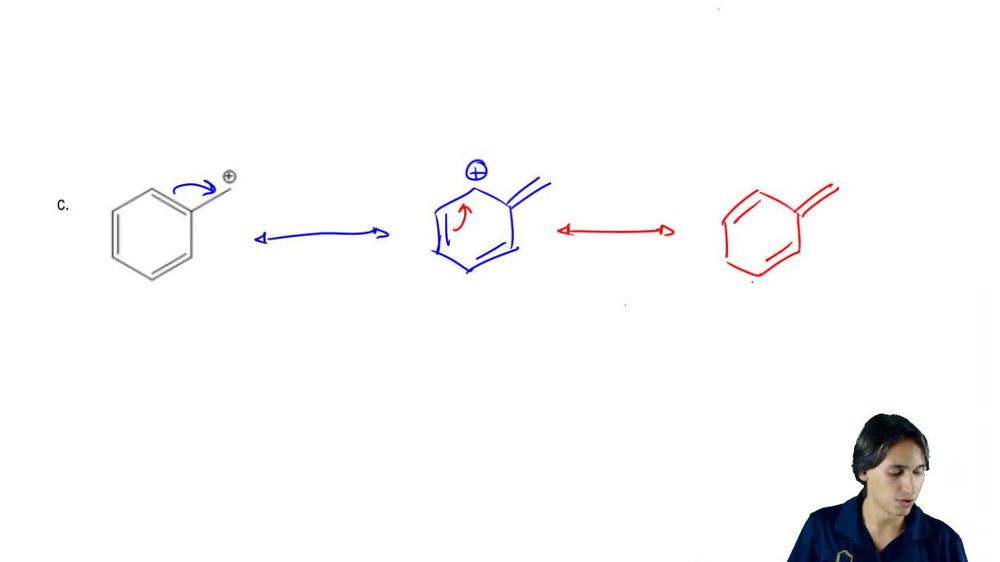
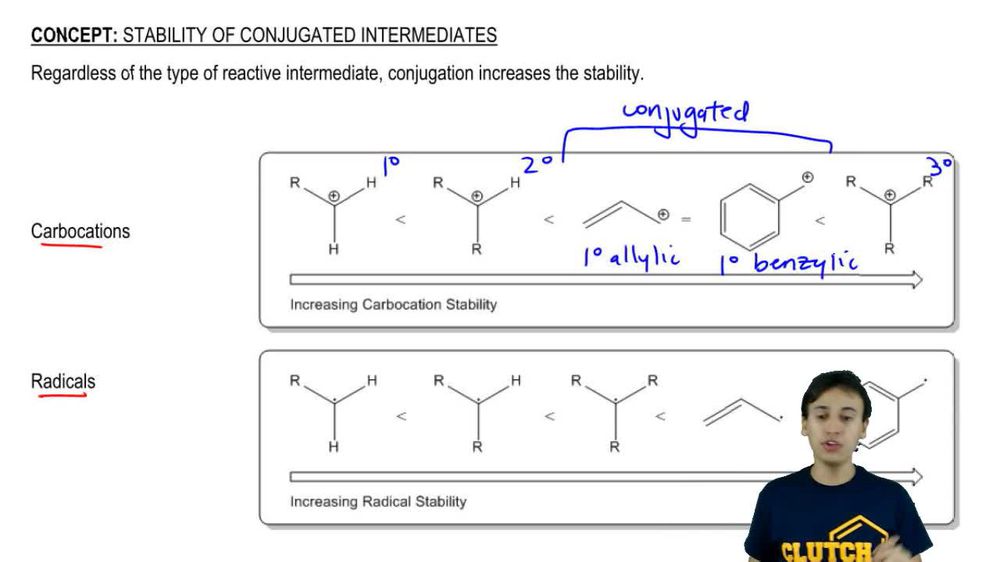
The following compounds can all react as acids. a. For each compound, show its conjugate base. Show any resonance forms if applicable. b. Rank the conjugate bases in the order you would predict, from most stable to least stable.
Verified step by step guidance
1
Identify the acidic hydrogen in each compound. For carboxylic acids like CH3COOH, CF3COOH, and CF3CH2COOH, the acidic hydrogen is the one attached to the oxygen in the -COOH group. For alcohols like CH3CH2OH, the acidic hydrogen is the one attached to the oxygen in the -OH group.
Remove the acidic hydrogen from each compound to form the conjugate base. For example, removing the hydrogen from CH3COOH results in CH3COO⁻.
Draw any resonance structures for the conjugate bases. For carboxylate ions like CH3COO⁻, resonance can be shown by delocalizing the negative charge between the two oxygen atoms.
Consider the stability of each conjugate base. Factors affecting stability include resonance, electronegativity, and inductive effects. For instance, the presence of electronegative atoms like fluorine in CF3COO⁻ can stabilize the conjugate base through inductive effects.
Rank the conjugate bases from most stable to least stable based on the factors discussed. Generally, more resonance and greater electronegativity lead to more stable conjugate bases.
Verified video answer for a similar problem:
This video solution was recommended by our tutors as helpful for the problem above
Video duration:
5m
Play a video:
0 Comments
Key Concepts
Here are the essential concepts you must grasp in order to answer the question correctly.
Conjugate Bases
A conjugate base is the species that remains after an acid donates a proton (H+). Understanding how to derive the conjugate base from an acid is crucial for predicting acid-base reactions. For example, when acetic acid (CH3COOH) donates a proton, it forms its conjugate base, acetate (CH3COO-). The stability of the conjugate base significantly influences the strength of the corresponding acid.
Resonance structures are different ways of drawing the same molecule that illustrate the delocalization of electrons. In the context of conjugate bases, resonance can stabilize the negative charge by spreading it over multiple atoms. For instance, the acetate ion has resonance forms that contribute to its stability, making it a more favorable conjugate base compared to others without such delocalization.
The strength of an acid is inversely related to the stability of its conjugate base; a more stable conjugate base corresponds to a stronger acid. Factors affecting stability include electronegativity, resonance, and inductive effects. For example, a conjugate base with a highly electronegative atom can stabilize a negative charge better, leading to a stronger acid. Ranking the stability of conjugate bases helps predict the relative strengths of the corresponding acids.

 5:45 minutes
 Verified step by step guidance
 03:27
03:27