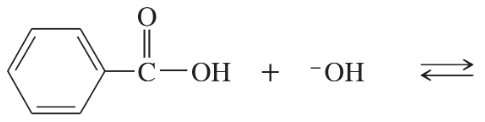
Predict the products of the following acid–base reactions. (c) (d)
Verified step by step guidance
1
Step 1: Identify the acid and base in each reaction. In reaction (c), the acid is benzoic acid (C₆H₅COOH) and the base is hydroxide ion (OH⁻). In reaction (d), the acid is carbonic acid (HOCOOH) and the base is hydroxide ion (OH⁻).
Step 2: Understand the acid-base reaction mechanism. The hydroxide ion (OH⁻) will deprotonate the acidic hydrogen from the carboxylic acid group (COOH) in both reactions.
Step 3: Predict the products for reaction (c). When benzoic acid (C₆H₅COOH) reacts with hydroxide ion (OH⁻), the product will be the benzoate ion (C₆H₅COO⁻) and water (H₂O).
Step 4: Predict the products for reaction (d). Carbonic acid (HOCOOH) will react with two hydroxide ions (OH⁻) to form carbonate ion (CO₃²⁻) and water (H₂O).
Step 5: Write the balanced chemical equations for each reaction. For reaction (c), C₆H₅COOH + OH⁻ ⇌ C₆H₅COO⁻ + H₂O. For reaction (d), HOCOOH + 2 OH⁻ ⇌ CO₃²⁻ + 2 H₂O.
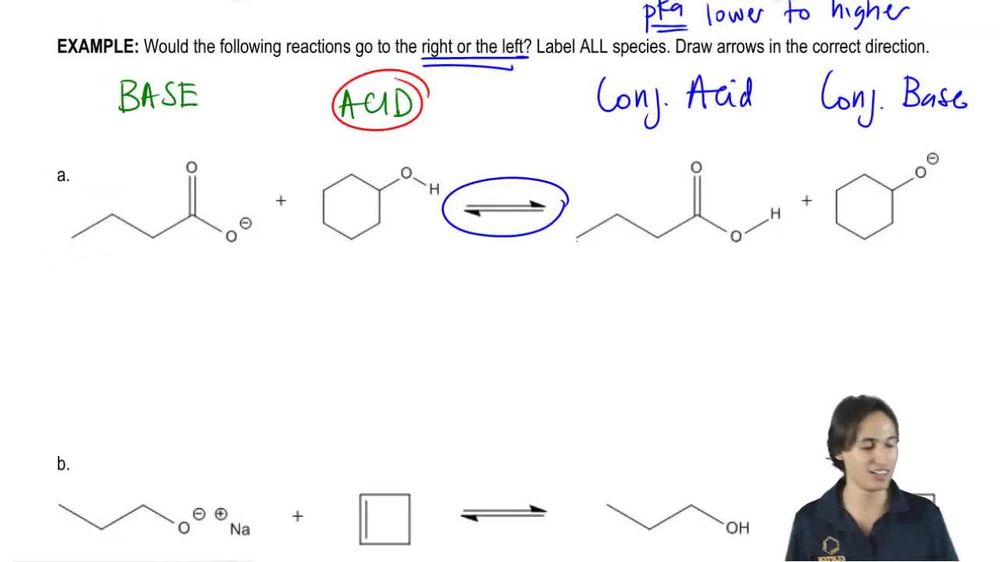
Verified video answer for a similar problem:
This video solution was recommended by our tutors as helpful for the problem above
Video duration:
3m
Play a video:
0 Comments
Key Concepts
Here are the essential concepts you must grasp in order to answer the question correctly.
Acid-Base Reactions
Acid-base reactions involve the transfer of protons (H+) between reactants. In organic chemistry, acids are proton donors, while bases are proton acceptors. Understanding the strength of acids and bases, as well as their conjugate pairs, is crucial for predicting the products of these reactions.
Many acid-base reactions are reversible and can reach a state of equilibrium, where the rate of the forward reaction equals the rate of the reverse reaction. The position of equilibrium can be influenced by factors such as concentration, temperature, and the nature of the reactants, which is essential for predicting the predominant products.
Resonance structures are different ways of drawing a molecule that represent the same compound. In the context of acid-base reactions, resonance can stabilize charged species, influencing their reactivity. Recognizing resonance can help predict the stability of intermediates and the overall direction of the reaction.