Predict the products of the following acid–base reactions. (a) H2SO4 + CH3COO– ⇌ (b) CH3COOH + (CH3)3N: ⇌
Verified step by step guidance
1
Identify the acid and base in each reaction. In reaction (a), H2SO4 is the acid and CH3COO- is the base. In reaction (b), CH3COOH is the acid and (CH3)3N is the base.
Determine the conjugate base of the acid and the conjugate acid of the base. For reaction (a), the conjugate base of H2SO4 is HSO4-. For reaction (b), the conjugate acid of (CH3)3N is (CH3)3NH+.
Write the products of the acid-base reaction. In reaction (a), the products are HSO4- and CH3COOH. In reaction (b), the products are CH3COO- and (CH3)3NH+.
Consider the equilibrium position. The strength of the acids and bases involved will determine the direction of the equilibrium. H2SO4 is a strong acid, so the equilibrium in reaction (a) will favor the formation of products. CH3COOH is a weak acid, so the equilibrium in reaction (b) may favor the reactants.
Review the reaction mechanism. In reaction (a), the proton transfer from H2SO4 to CH3COO- forms HSO4- and CH3COOH. In reaction (b), the proton transfer from CH3COOH to (CH3)3N forms CH3COO- and (CH3)3NH+.
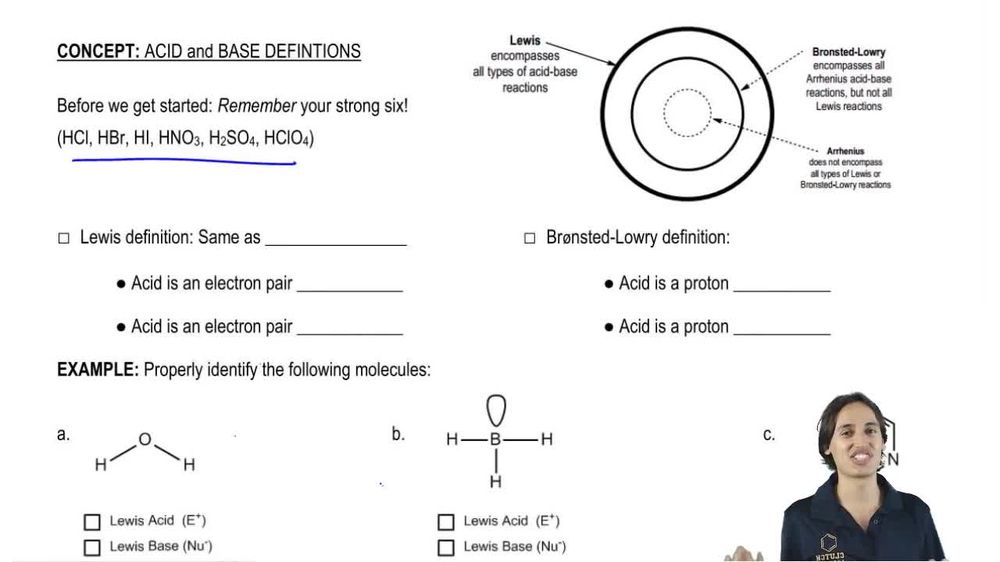
Verified video answer for a similar problem:
This video solution was recommended by our tutors as helpful for the problem above
Video duration:
3m
Play a video:
0 Comments
Key Concepts
Here are the essential concepts you must grasp in order to answer the question correctly.
Acid-Base Reaction
Acid-base reactions involve the transfer of protons (H+) from an acid to a base. In organic chemistry, these reactions often result in the formation of a conjugate acid and a conjugate base. Understanding the strength and structure of the acids and bases involved is crucial for predicting the products.
A conjugate acid-base pair consists of two species that differ by a proton. When an acid donates a proton, it forms its conjugate base, and when a base accepts a proton, it forms its conjugate acid. Identifying these pairs helps in predicting the direction and products of acid-base reactions.
The pKa value is a measure of the acidity of a compound, indicating how easily it donates a proton. Lower pKa values correspond to stronger acids. Comparing the pKa values of the acids involved in a reaction helps determine the equilibrium position and the predominant species in the reaction mixture.

 3:09 minutes
 Verified step by step guidance
 02:49
02:49