Label the reactants in these acid–base reactions as Lewis acids (electrophiles) or Lewis bases (nucleophiles). Use curved arrows to show the movement of electron pairs in the reactions. (c)
Verified step by step guidance
1
Identify the reactants: In the given reaction, the reactants are formaldehyde (HCOH) and ammonia (NH3).
Determine the Lewis acid and Lewis base: A Lewis acid is an electron pair acceptor, while a Lewis base is an electron pair donor. In this reaction, formaldehyde (HCOH) acts as the Lewis acid because the carbonyl carbon can accept an electron pair. Ammonia (NH3) acts as the Lewis base because it has a lone pair of electrons on the nitrogen atom that can be donated.
Draw the curved arrow notation: Use a curved arrow to show the movement of the electron pair from the nitrogen atom of NH3 to the carbonyl carbon of HCOH. This represents the nucleophilic attack of the Lewis base on the Lewis acid.
Analyze the product formation: As a result of the electron pair donation, the carbonyl carbon forms a new bond with the nitrogen atom, resulting in the formation of a tetrahedral intermediate. The oxygen atom in the carbonyl group gains a negative charge, and the nitrogen atom gains a positive charge.
Label the products: The products of the reaction are the ammonium ion (NH4+) and the alkoxide ion (CH3C(OH)CH3-). The ammonium ion is formed by the protonation of NH3, and the alkoxide ion is formed by the deprotonation of the hydroxyl group in the intermediate.
Verified video answer for a similar problem:
This video solution was recommended by our tutors as helpful for the problem above
Video duration:
3m
Play a video:
0 Comments
Key Concepts
Here are the essential concepts you must grasp in order to answer the question correctly.
Lewis Acids and Bases
Lewis acids are species that can accept an electron pair, while Lewis bases are species that can donate an electron pair. In the given reaction, the carbonyl compound acts as a Lewis acid due to the electrophilic carbon, and ammonia acts as a Lewis base because it has a lone pair of electrons available for donation.
Curved arrows are used in organic chemistry to illustrate the movement of electron pairs during chemical reactions. The tail of the arrow indicates the source of the electrons, while the head points to where the electrons are going. This notation helps visualize the flow of electrons, which is crucial for understanding reaction mechanisms.
Acid-base reactions involve the transfer of protons (H+) or electron pairs between reactants. In this case, the reaction between the carbonyl compound and ammonia is an acid-base reaction where the Lewis base (ammonia) donates an electron pair to the Lewis acid (carbonyl), forming a new bond and resulting in a charged intermediate.

 3:04 minutes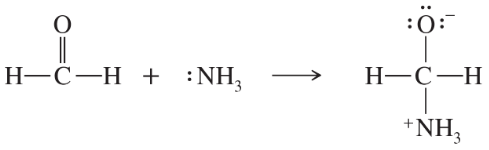
 Verified step by step guidance
 02:49
02:49