Will a concerted reaction take place between 1,3-butadiene and 2-cyclohexenone in the presence of ultraviolet light?
Verified step by step guidance
1
Identify the type of reaction: The problem involves 1,3-butadiene and 2-cyclohexenone, which suggests a potential pericyclic reaction. Since ultraviolet (UV) light is mentioned, this indicates the possibility of a photochemical reaction, such as a [2+2] cycloaddition.
Understand the reaction conditions: In the presence of UV light, pericyclic reactions follow the photochemical selection rules. These rules are based on the Woodward-Hoffmann principles, which determine whether a reaction is allowed under thermal or photochemical conditions.
Analyze the molecular orbitals: For a [2+2] cycloaddition to occur, the reaction must involve the interaction of the HOMO (highest occupied molecular orbital) of one molecule with the LUMO (lowest unoccupied molecular orbital) of the other. Under photochemical conditions, the electronic excitation alters the orbital symmetry, making the reaction symmetry-allowed.
Determine the feasibility of the reaction: 1,3-butadiene has a conjugated π-system, and 2-cyclohexenone contains a double bond in a cyclic structure. Under UV light, the π-electrons in these molecules can be excited, allowing the reaction to proceed via a concerted mechanism. This makes the [2+2] cycloaddition between these two molecules feasible.
Conclude the reaction type: Based on the analysis, a concerted [2+2] cycloaddition reaction is likely to occur between 1,3-butadiene and 2-cyclohexenone in the presence of UV light, as it satisfies the photochemical selection rules.
Verified video answer for a similar problem:
This video solution was recommended by our tutors as helpful for the problem above
Video duration:
7m
Play a video:
0 Comments
Key Concepts
Here are the essential concepts you must grasp in order to answer the question correctly.
Concerted Reactions
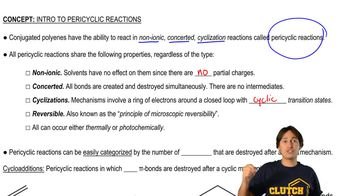
Concerted reactions are chemical processes where bond breaking and bond forming occur simultaneously in a single step, without intermediates. This mechanism is crucial in understanding how certain reactions proceed, particularly in systems with multiple reactive sites. The stereochemistry and regioselectivity of the products are often determined by the concerted nature of the reaction.
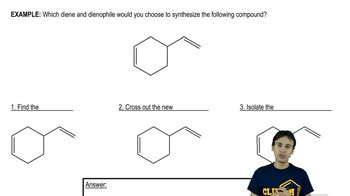
The Diels-Alder reaction is a specific type of concerted reaction involving a diene and a dienophile, leading to the formation of a six-membered ring. In this context, 1,3-butadiene acts as the diene, while 2-cyclohexenone serves as the dienophile. This reaction is thermally allowed and can be influenced by light, making it relevant to the question of ultraviolet light's effect.
Ultraviolet (UV) light can provide the energy necessary to promote certain organic reactions, particularly those involving excited states or radical mechanisms. In the context of the question, UV light may facilitate the Diels-Alder reaction by promoting the diene or dienophile to a reactive state, potentially altering the reaction pathway or rate. Understanding the role of UV light is essential for predicting the feasibility of the reaction.