Ch. 15 - Conjugated Systems, Orbital Symmetry, and Ultraviolet Spectroscopy
Wade - Organic Chemistry 9th Edition
Wade9th EditionOrganic ChemistryISBN: 9780135213728Not the one you use?Change textbook
Chapter 15, Problem 36c

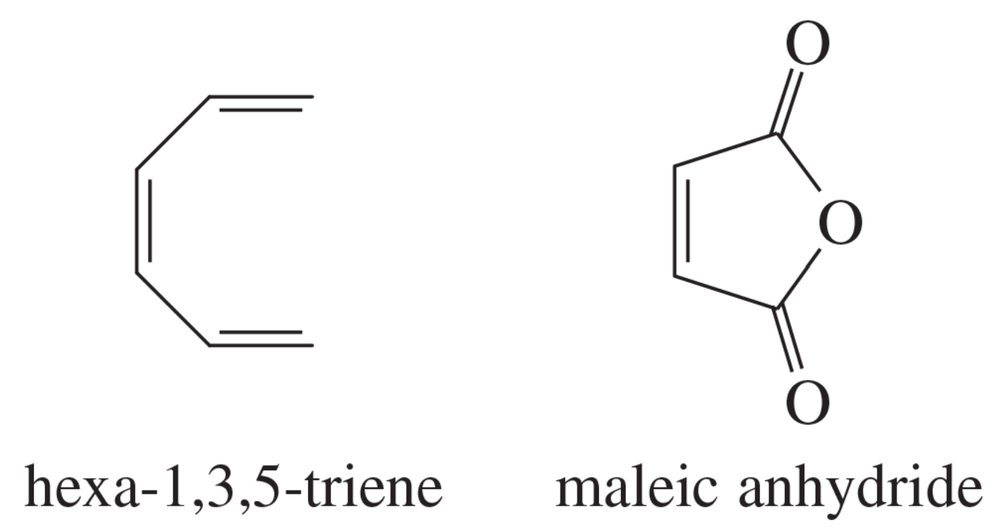
Show what product would result from the [6 + 2] cycloaddition of hexa-1,3,5-triene with maleic anhydride.
Chemical structures of hexa-1,3,5-triene and maleic anhydride labeled below each structure.

Verified step by step guidance
1
Step 1: Recognize that the reaction described is a [6 + 2] cycloaddition. This type of reaction involves the combination of a six-electron π-system (hexa-1,3,5-triene) and a two-electron π-system (maleic anhydride) to form a cyclic product.
Step 2: Analyze the structure of hexa-1,3,5-triene. It contains three conjugated double bonds, which form a six-electron π-system. This makes it suitable for participating in a cycloaddition reaction.
Step 3: Examine the structure of maleic anhydride. It contains a two-electron π-system in its double bond, and the anhydride functional group provides electron-withdrawing properties, making it an excellent dienophile for cycloaddition reactions.
Step 4: Predict the reaction mechanism. The [6 + 2] cycloaddition occurs via a concerted mechanism, where the π-electrons of hexa-1,3,5-triene interact with the π-electrons of maleic anhydride to form a new cyclic structure. The reaction forms two new σ-bonds and a new π-bond in the cyclic product.
Step 5: Draw the product structure. The resulting product will be an eight-membered ring containing the original maleic anhydride functional group and the conjugated system from hexa-1,3,5-triene. Ensure the stereochemistry and connectivity are consistent with the concerted cycloaddition mechanism.

Verified video answer for a similar problem:

This video solution was recommended by our tutors as helpful for the problem above.
Video duration:
4m
Was this helpful?

Key Concepts

Here are the essential concepts you must grasp in order to answer the question correctly.

Cycloaddition Reactions

Cycloaddition reactions involve the formation of a cyclic compound from two or more reactants. In this case, the [6 + 2] cycloaddition refers to a reaction where a six-membered system (hexa-1,3,5-triene) reacts with a two-component system (maleic anhydride) to form a larger cyclic product. Understanding the mechanism and stereochemistry of cycloaddition is crucial for predicting the structure of the resulting compound.
Recommended video:
Guided course
08:29
Cycloadditions Summary Chart

Hexa-1,3,5-triene

Hexa-1,3,5-triene is a conjugated diene with alternating double bonds, which makes it highly reactive in cycloaddition reactions. Its structure allows for the overlap of p-orbitals during the reaction, facilitating the formation of new sigma bonds. Recognizing the reactivity patterns of such conjugated systems is essential for predicting the outcome of the reaction with maleic anhydride.
Recommended video:
1:47
Oxidation of Phenols to Quinones Concept 1

Maleic Anhydride

Maleic anhydride is a cyclic anhydride that acts as a dienophile in Diels-Alder reactions. Its electrophilic nature allows it to react with nucleophilic diene systems like hexa-1,3,5-triene. Understanding the properties of maleic anhydride, including its ability to stabilize the transition state and influence the regioselectivity of the reaction, is vital for determining the final product of the cycloaddition.
Recommended video:
Guided course
03:35
Anhydride Nomenclature