Ch. 22 - Conjugated Systems II: Pericyclic Reactions
Mullins - Organic Chemistry: A Learner Centered Approach 1st Edition
Mullins1st EditionOrganic Chemistry: A Learner Centered ApproachISBN: 9780137566471Not the one you use?Change textbook
Chapter 21, Problem 50

The [2 + 2] cyclization is especially useful when done intramolecularly. 
(a) What makes intramolecular reactions more favorable? 
(b) Predict the product of the following cyclization (slight modification of a reaction from Angew. Chem. 2011, 50, 5149)
Chemical structure illustrating a [2 + 2] cyclization reaction with hydroxyl and methoxy groups, indicating photochemical conditions.

Verified step by step guidance
1
Intramolecular reactions are more favorable because they involve the reaction of functional groups within the same molecule, which reduces the entropy loss compared to intermolecular reactions. This proximity increases the effective concentration of the reacting groups, leading to a higher reaction rate.
In the given structure, identify the two alkenes that will participate in the [2 + 2] cycloaddition. The reaction is photochemically induced, as indicated by the 'hv' symbol, which suggests that the reaction will proceed via a photochemical pathway.
The [2 + 2] cycloaddition involves the formation of a four-membered ring by the interaction of two π-bonds. In this case, the reaction is intramolecular, meaning the two alkenes are part of the same molecule.
Consider the stereochemistry of the starting material. The stereochemistry of the product will be influenced by the stereochemistry of the starting alkenes and the mechanism of the cycloaddition. Photochemical [2 + 2] cycloadditions often proceed with retention of configuration.
Draw the product of the cyclization, ensuring that the new four-membered ring is formed between the two alkenes. Pay attention to the stereochemistry of the newly formed ring and any existing stereocenters in the molecule.

Verified video answer for a similar problem:

This video solution was recommended by our tutors as helpful for the problem above.
Video duration:
9m
Was this helpful?

Key Concepts

Here are the essential concepts you must grasp in order to answer the question correctly.

Intramolecular Reactions

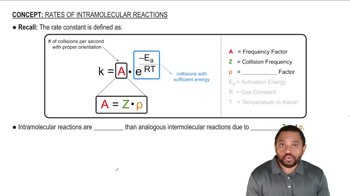
Intramolecular reactions occur within a single molecule, allowing reactive groups to come into close proximity. This proximity increases the likelihood of successful collisions between reactants, leading to a higher reaction rate. Additionally, intramolecular reactions often benefit from reduced entropic penalties compared to intermolecular reactions, making them thermodynamically more favorable.
Recommended video:
2:29
Rates of Intramolecular Reactions Concept 1

Cyclization

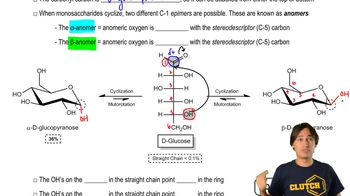
Cyclization refers to the process of forming a cyclic compound from a linear precursor. In organic chemistry, this often involves the formation of rings through the reaction of functional groups within the same molecule. The stability of the resulting cyclic structure can be influenced by factors such as ring strain and the presence of substituents, which can affect the overall reactivity and product distribution.
Recommended video:
Guided course
12:58
Monosaccharides - Cyclization

Reaction Mechanism

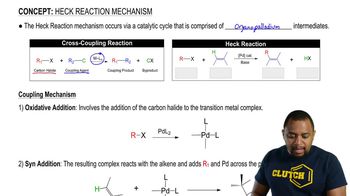
A reaction mechanism outlines the step-by-step sequence of elementary reactions that occur during a chemical transformation. Understanding the mechanism is crucial for predicting the products of a reaction, as it reveals how bonds are broken and formed. In the context of cyclization, knowing the mechanism helps in anticipating the stereochemistry and regioselectivity of the final product.
Recommended video:
Guided course
02:16
Heck Reaction Mechanism