Ch. 22 - Conjugated Systems II: Pericyclic Reactions
Mullins - Organic Chemistry: A Learner Centered Approach 1st Edition
Mullins1st EditionOrganic Chemistry: A Learner Centered ApproachISBN: 9780137566471Not the one you use?Change textbook
Chapter 21, Problem 27a

Predict the product of the following [2 + 2] cycloadditions.
(a) Chemical structures illustrating a [2 + 2] cycloaddition reaction with light energy input indicated.

Verified step by step guidance
1
Identify the reactants: The given reactants are two alkenes, each with a double bond. The reaction is a [2 + 2] cycloaddition, which involves the formation of a four-membered ring from two alkenes.
Understand the reaction conditions: The reaction is photochemical, as indicated by the 'hv' symbol, which means it is initiated by light. Photochemical [2 + 2] cycloadditions are allowed due to the involvement of excited states.
Determine the mechanism: In a [2 + 2] cycloaddition, the pi bonds of the alkenes interact to form two new sigma bonds, resulting in a cyclobutane ring. The reaction proceeds through a concerted mechanism in the excited state.
Visualize the product: The two alkenes will align such that their double bonds are parallel, allowing the formation of a new four-membered ring. Each carbon of the double bonds will form a new bond with the adjacent carbon of the other alkene.
Draw the product: The product will be a cyclobutane ring with the original substituents of the alkenes attached to the ring. Ensure that the stereochemistry is considered, as the reaction can lead to different stereoisomers depending on the orientation of the substituents.

Verified video answer for a similar problem:

This video solution was recommended by our tutors as helpful for the problem above.
Video duration:
2m
Was this helpful?

Key Concepts

Here are the essential concepts you must grasp in order to answer the question correctly.

[2 + 2] Cycloaddition

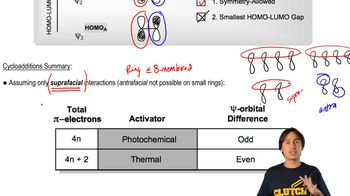
[2 + 2] Cycloaddition is a chemical reaction where two alkenes or alkynes combine to form a cyclobutane ring. This reaction is symmetry-forbidden under thermal conditions due to the conservation of orbital symmetry, but it can proceed under photochemical conditions, as indicated by the use of light (hv) in the reaction. The reaction involves the formation of two new sigma bonds between the participating pi systems.
Recommended video:
Guided course
08:29
Cycloadditions Summary Chart

Photochemical Reactions

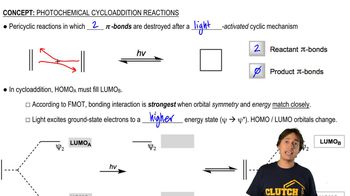
Photochemical reactions are chemical reactions initiated by the absorption of light. In organic chemistry, light energy can promote electrons to higher energy states, allowing reactions that are otherwise forbidden under thermal conditions. In the context of [2 + 2] cycloadditions, light provides the necessary energy to overcome symmetry restrictions, enabling the formation of cyclobutane rings from alkenes.
Recommended video:
Guided course
09:36
MO Theory of Photochemical Cycloadditions

Conservation of Orbital Symmetry

The conservation of orbital symmetry is a principle that governs the feasibility of pericyclic reactions, such as cycloadditions. It states that the symmetry of the molecular orbitals must be conserved during the reaction. In [2 + 2] cycloadditions, thermal reactions are symmetry-forbidden, but photochemical conditions alter the symmetry properties, allowing the reaction to proceed by promoting electrons to excited states, thus enabling the formation of new bonds.
Recommended video:
Guided course
00:25
Determining Chirality with Plane of Symmetry