Ch. 13 - Mass Spectrometry; Infrared Spectroscopy; UV/Vis Spectroscopy
Bruice - Organic Chemistry 8th Edition
Bruice8th EditionOrganic ChemistryISBN: 9780135213711Not the one you use?Change textbook
Chapter 14, Problem 5b

Determine the molecular formula for each of the following:
b. a compound that contains C, H, and one O and has a molecular ion with an m/z value of 100

Verified step by step guidance
1
Step 1: Understand the problem. The molecular ion peak (m/z = 100) represents the molecular weight of the compound. The compound contains carbon (C), hydrogen (H), and one oxygen (O). We need to determine the molecular formula that matches this molecular weight.
Step 2: Assign a general molecular formula for the compound. Since the compound contains C, H, and O, we can write the formula as \( C_xH_yO \), where \( x \), \( y \), and the single oxygen atom contribute to the molecular weight of 100.
Step 3: Calculate the contribution of each element to the molecular weight. The atomic weights are approximately: C = 12, H = 1, and O = 16. Use the formula \( 12x + y + 16 = 100 \) to represent the molecular weight.
Step 4: Solve for \( x \) and \( y \). Start by testing integer values for \( x \) (number of carbons) and calculate \( y \) (number of hydrogens) such that the total molecular weight equals 100. Ensure that \( y \) is a positive integer.
Step 5: Verify the molecular formula. Once you find values for \( x \) and \( y \) that satisfy the equation \( 12x + y + 16 = 100 \), confirm that the formula matches the given constraints (contains C, H, and one O) and has the correct molecular weight.

Verified video answer for a similar problem:

This video solution was recommended by our tutors as helpful for the problem above.
Video duration:
3m
Was this helpful?

Key Concepts

Here are the essential concepts you must grasp in order to answer the question correctly.

Molecular Formula

The molecular formula of a compound indicates the types and numbers of atoms present in a molecule. It is expressed as a combination of element symbols and subscripts, such as CxHyOz, where x, y, and z represent the number of carbon, hydrogen, and oxygen atoms, respectively. Understanding how to derive a molecular formula is essential for identifying the composition of organic compounds.
Recommended video:
Guided course
02:17
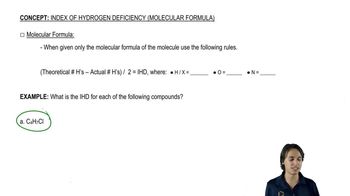
How to use IHD with molecular formula.

Mass-to-Charge Ratio (m/z)

The mass-to-charge ratio (m/z) is a crucial concept in mass spectrometry, representing the mass of an ion divided by its charge. In the context of the question, an m/z value of 100 indicates that the molecular ion of the compound has a mass of 100 daltons. This information helps in deducing the possible molecular formula by correlating the m/z value with the number of atoms in the compound.
Recommended video:
Guided course
10:48
Equipment and Theory

Empirical Formula

The empirical formula represents the simplest whole-number ratio of the elements in a compound. It is particularly useful when determining the molecular formula, especially when the molecular weight is known. For a compound containing carbon, hydrogen, and oxygen, the empirical formula can provide insights into the possible combinations of these elements that yield the specified m/z value.
Recommended video:
Guided course
02:17
How to use IHD with molecular formula.