Predict the major products of the following reactions, and give the structures of any intermediates. Include stereochemistry where appropriate. (j)
Verified step by step guidance
1
Step 1: Analyze the reaction conditions. The reagents CH₃CO₃H (peracetic acid) and H⁺, H₂O indicate that this is an epoxidation reaction followed by acid-catalyzed ring opening of the epoxide.
Step 2: Identify the starting material. The structure is a cyclohexene ring with one double bond. The double bond will react with the peracetic acid to form an epoxide intermediate.
Step 3: Predict the stereochemistry of the epoxide formation. The epoxidation occurs via a syn addition mechanism, meaning the oxygen atom from the peracetic acid will add to the same face of the double bond.
Step 4: Consider the acid-catalyzed ring opening of the epoxide. In the presence of H⁺ and H₂O, the epoxide will undergo nucleophilic attack by water, leading to the formation of a diol. The attack typically occurs at the more substituted carbon of the epoxide, following Markovnikov's rule.
Step 5: Predict the final product. The reaction will yield a trans-1,2-diol due to the anti addition mechanism during the ring opening step. Ensure stereochemistry is properly represented in the final structure.
Verified video answer for a similar problem:
This video solution was recommended by our tutors as helpful for the problem above
Video duration:
7m
Play a video:
0 Comments
Key Concepts
Here are the essential concepts you must grasp in order to answer the question correctly.
Electrophilic Aromatic Substitution (EAS)
Electrophilic Aromatic Substitution is a fundamental reaction in organic chemistry where an electrophile replaces a hydrogen atom on an aromatic ring. This process is crucial for understanding how aromatic compounds react, as the stability of the aromatic system allows for substitution rather than addition. The reaction typically involves the formation of a sigma complex (arenium ion) as an intermediate, which is then deprotonated to restore aromaticity.
Carboxylic acids, such as acetic acid (CH3COOH), can act as electrophiles in organic reactions, particularly when activated by a catalyst like H+. In the context of EAS, the carboxylic acid can protonate to form a more reactive electrophile, facilitating the substitution reaction on the aromatic ring. Understanding the role of carboxylic acids in these reactions is essential for predicting the products of the reaction.
Stereochemistry refers to the spatial arrangement of atoms in molecules and how this affects their chemical behavior. In reactions involving chiral centers, the stereochemistry of the reactants can influence the stereochemical outcome of the products. When predicting products, it is important to consider whether the reaction leads to the formation of new chiral centers and how this impacts the overall stereochemical configuration of the resulting compounds.

 7:01 minutes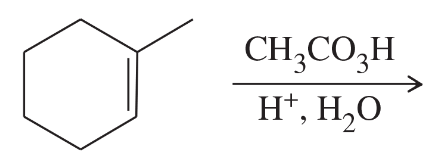
 Verified step by step guidance
 03:07
03:07