Predict the product(s) of each of the following reactions, making sure to indicate the relative stereochemical outcome. Indicate any racemic mixtures by drawing both enantiomers. (b)
Verified step by step guidance
1
Analyze the type of reaction: Determine the reaction type (e.g., substitution, elimination, addition, etc.) based on the reagents and reaction conditions provided. For example, if the reaction involves a nucleophile and an alkyl halide, it might be a substitution reaction.
Identify the starting material: Examine the structure of the reactant(s) and note any functional groups, stereochemistry, or other relevant features that will influence the reaction outcome.
Determine the mechanism: Based on the reaction type, predict the mechanism (e.g., SN1, SN2, E1, E2, etc.). For example, if the reaction involves a strong nucleophile and a primary alkyl halide, an SN2 mechanism is likely.
Predict the product(s): Using the mechanism, determine the structure of the product(s). Pay attention to regioselectivity (e.g., Markovnikov or anti-Markovnikov addition) and stereoselectivity (e.g., syn or anti addition). If the reaction produces a racemic mixture, draw both enantiomers.
Indicate stereochemistry: Clearly indicate the relative stereochemical outcome of the product(s). For example, if the reaction produces a racemic mixture, explicitly show both enantiomers and label them as such. If the product has a specific stereochemistry, use wedge and dash bonds to represent it.
Verified video answer for a similar problem:
This video solution was recommended by our tutors as helpful for the problem above
Video duration:
3m
Play a video:
0 Comments
Key Concepts
Here are the essential concepts you must grasp in order to answer the question correctly.
Reaction Mechanisms
Understanding reaction mechanisms is crucial in organic chemistry as they describe the step-by-step process by which reactants transform into products. This includes identifying intermediates, transition states, and the movement of electrons. Knowledge of mechanisms helps predict the products and their stereochemistry based on the type of reaction, such as nucleophilic substitutions or eliminations.
Stereochemistry involves the study of the spatial arrangement of atoms in molecules and how this affects their chemical behavior. It is essential for predicting the relative stereochemical outcomes of reactions, including the formation of chiral centers and the possibility of enantiomers. Understanding concepts like chirality, diastereomers, and racemic mixtures is vital for accurately representing the products of reactions.
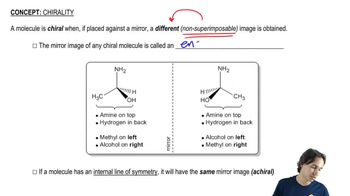
Chirality refers to the property of a molecule that makes it non-superimposable on its mirror image, leading to the existence of enantiomers—two molecules that are mirror images of each other. In reactions that create chiral centers, it is important to determine whether one or both enantiomers are produced. Recognizing racemic mixtures, which contain equal amounts of both enantiomers, is also key in predicting the stereochemical outcome of reactions.

 3:04 minutes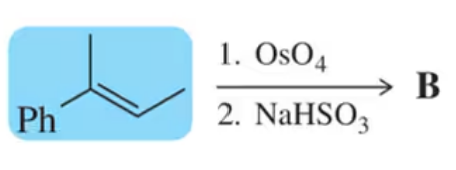
 Verified step by step guidance

 02:16
02:16