Show how you would accomplish the following conversions. a. cis-hex-3-ene to meso-hexane-3,4-diol
Verified step by step guidance
1
Identify the type of reaction needed for the conversion. The transformation from cis-hex-3-ene to meso-hexane-3,4-diol involves the addition of hydroxyl groups (-OH) to the double bond in a syn fashion. This suggests a syn-dihydroxylation reaction.
Choose an appropriate reagent for syn-dihydroxylation. A common reagent for this reaction is osmium tetroxide (OsO₄) in the presence of a co-oxidant like N-methylmorpholine N-oxide (NMO) or hydrogen peroxide (H₂O₂). Alternatively, potassium permanganate (KMnO₄) under cold, dilute conditions can also be used.
Write the reaction mechanism. The double bond in cis-hex-3-ene reacts with the OsO₄ or KMnO₄ to form a cyclic osmate ester or manganate intermediate. This intermediate ensures that the hydroxyl groups are added to the same face of the double bond (syn addition).
Hydrolyze the intermediate. The cyclic intermediate is then hydrolyzed with water to yield the diol product, meso-hexane-3,4-diol. The meso compound arises because the starting alkene is cis, and the syn addition leads to a product with internal symmetry.
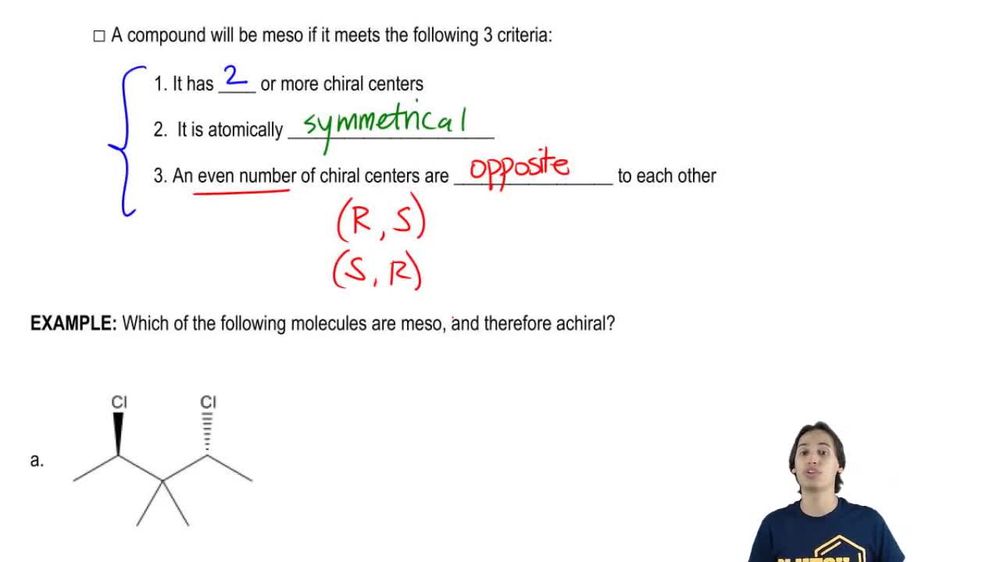
Verify the stereochemistry of the product. The meso-hexane-3,4-diol has two chiral centers, but due to the symmetry of the molecule, it is optically inactive. This confirms the correct stereochemical outcome of the reaction.
Verified video answer for a similar problem:
This video solution was recommended by our tutors as helpful for the problem above
Video duration:
2m
Play a video:
0 Comments
Key Concepts
Here are the essential concepts you must grasp in order to answer the question correctly.
Alkenes and Stereochemistry
Alkenes are hydrocarbons that contain at least one carbon-carbon double bond, which introduces geometric isomerism due to restricted rotation around the double bond. In this case, cis-hex-3-ene has substituents on the same side of the double bond, leading to specific stereochemical properties that are crucial for understanding the conversion to a diol.
Hydroxylation is the addition of hydroxyl groups (-OH) to a compound, often involving alkenes. In the conversion of cis-hex-3-ene to meso-hexane-3,4-diol, a common method is syn-dihydroxylation, where two hydroxyl groups are added to the same side of the double bond, resulting in a meso compound with internal symmetry.
Meso compounds are achiral molecules that contain multiple stereocenters but possess an internal plane of symmetry. In the case of meso-hexane-3,4-diol, the addition of hydroxyl groups to the cis-alkene leads to a compound that is superimposable on its mirror image, making it optically inactive despite having stereocenters.