c. Which amino acid has the greatest amount of negative charge at pH = 6.20?
Verified step by step guidance
1
Identify the amino acids that have side chains capable of carrying a negative charge at physiological pH. These are typically the acidic amino acids, such as aspartic acid (Asp, D) and glutamic acid (Glu, E), which have carboxylic acid (-COOH) groups in their side chains.
Determine the pKa values of the side chain carboxylic acid groups for aspartic acid and glutamic acid. The pKa values are approximately 3.9 for aspartic acid and 4.2 for glutamic acid.
Compare the given pH (6.20) to the pKa values of the side chains. At a pH higher than the pKa, the carboxylic acid groups will be deprotonated, resulting in a negative charge. Use the Henderson-Hasselbalch equation to confirm the degree of deprotonation: \( \text{pH} = \text{pKa} + \log \left( \frac{[\text{A}^-]}{[\text{HA}]} \right) \).
Since the pH (6.20) is significantly higher than both pKa values (3.9 and 4.2), the side chains of both aspartic acid and glutamic acid will be almost fully deprotonated and negatively charged. However, consider the total number of carboxylic acid groups in each amino acid to determine which has the greatest overall negative charge.
Conclude that the amino acid with the greatest amount of negative charge at pH 6.20 is the one with the most deprotonated carboxylic acid groups, taking into account both the side chain and the carboxyl group in the backbone.
Verified video answer for a similar problem:
This video solution was recommended by our tutors as helpful for the problem above
Play a video:
0 Comments
Key Concepts
Here are the essential concepts you must grasp in order to answer the question correctly.
Amino Acid Structure
Amino acids are organic compounds that serve as the building blocks of proteins. Each amino acid has a central carbon atom bonded to an amino group (–NH2), a carboxyl group (–COOH), a hydrogen atom, and a variable side chain (R group). The properties of the side chain determine the amino acid's characteristics, including its charge at a given pH.
pH is a measure of the acidity or basicity of a solution, influencing the ionization of functional groups in amino acids. At a specific pH, the carboxyl group of an amino acid typically donates a proton, becoming negatively charged (–COO⁻), while the amino group can accept a proton, becoming positively charged (–NH3⁺). The overall charge of the amino acid depends on the pKa values of these groups relative to the pH.
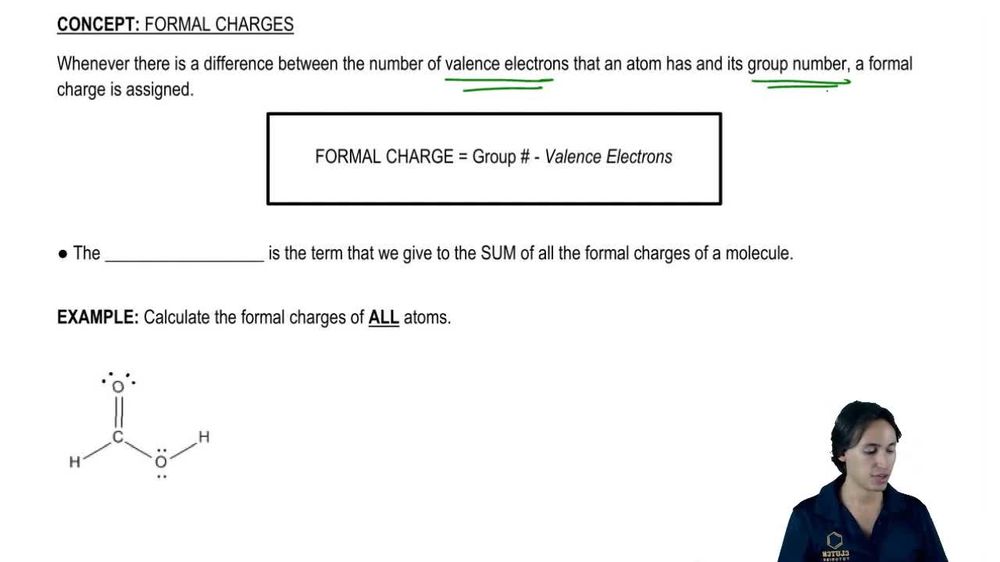
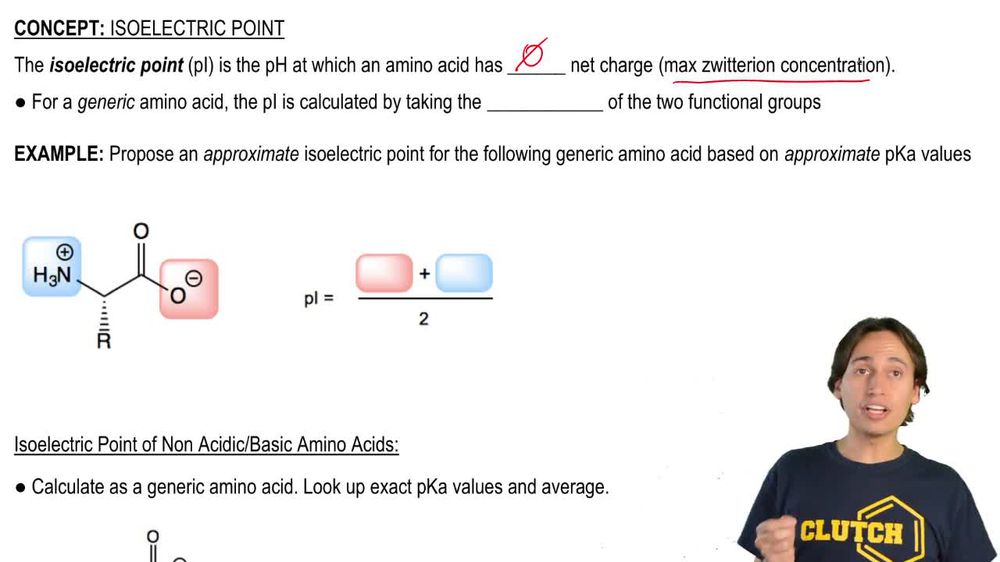
The isoelectric point (pI) is the pH at which an amino acid has no net charge, meaning the positive and negative charges balance each other. Amino acids with acidic side chains, such as aspartic acid and glutamic acid, tend to have lower pI values and can carry a negative charge at physiological pH levels. Understanding the pI helps predict the charge of amino acids at specific pH values.

 Verified step by step guidance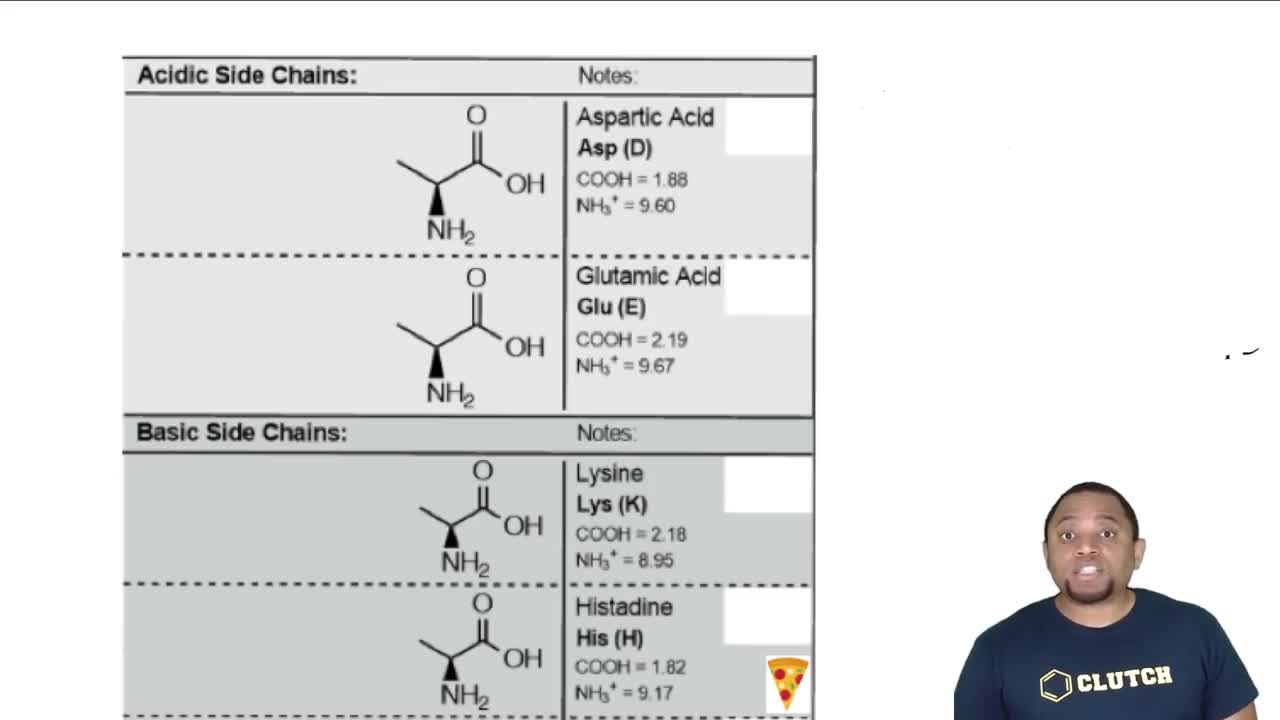
 11:14
11:14