Draw the predominant form for glutamate in a solution with the following pH: a. 0
Verified step by step guidance
1
Identify the functional groups in glutamate: Glutamate is an amino acid with an amine group (-NH₂), a carboxylic acid group (-COOH), and a side chain containing another carboxylic acid group (-COOH).
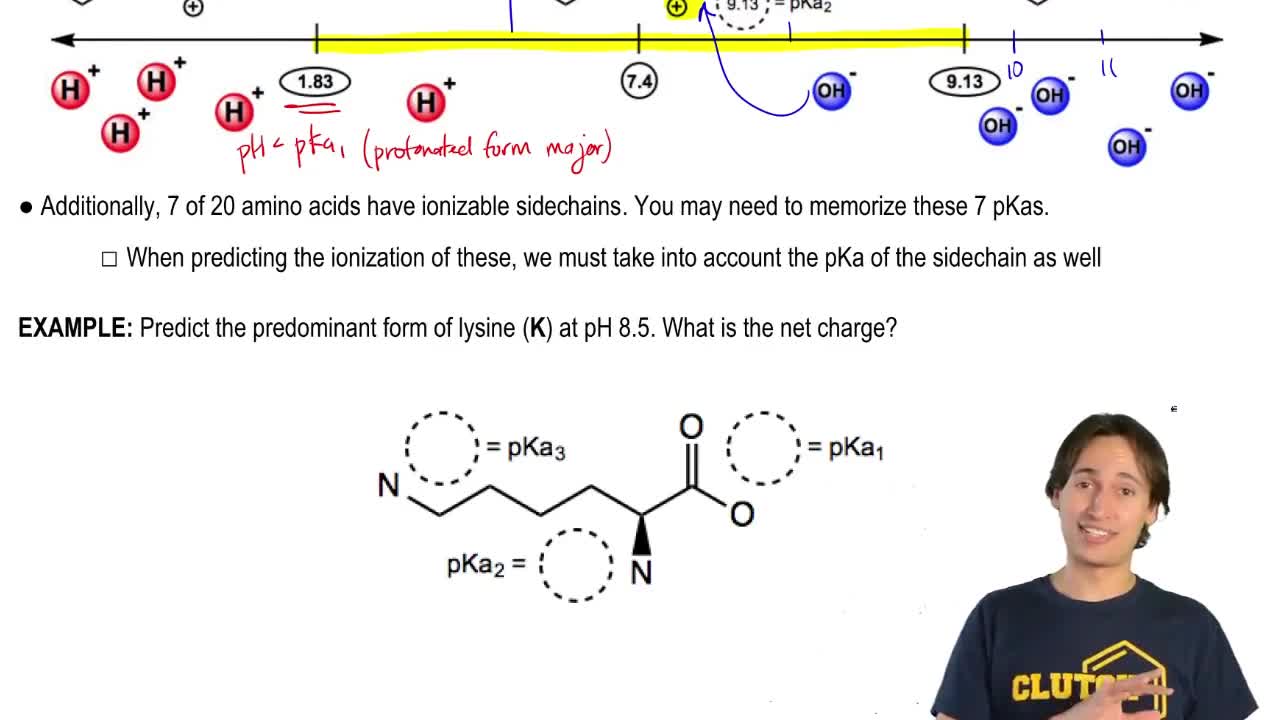
Understand the pKa values of the functional groups: The pKa values for glutamate are approximately 2.1 for the α-carboxylic acid group, 4.1 for the side chain carboxylic acid group, and 9.7 for the α-amino group.
Compare the pH of the solution (pH = 0) to the pKa values: At pH = 0, the solution is highly acidic, meaning the environment will protonate all ionizable groups in glutamate.
Determine the protonation state of each group: At pH = 0, both carboxylic acid groups (-COOH) will remain in their protonated form, and the amine group (-NH₂) will be protonated to form -NH₃⁺.
Draw the structure of glutamate in its fully protonated form: The α-carboxylic acid group and the side chain carboxylic acid group will both be -COOH, and the α-amino group will be -NH₃⁺. Ensure the correct connectivity of the molecule is shown.
Verified video answer for a similar problem:
This video solution was recommended by our tutors as helpful for the problem above
Play a video:
0 Comments
Key Concepts
Here are the essential concepts you must grasp in order to answer the question correctly.
Amino Acids and Their Ionization
Amino acids, like glutamate, can exist in different ionic forms depending on the pH of the solution. At low pH, amino acids tend to be protonated, meaning they carry a positive charge. Understanding the ionization of amino acids is crucial for predicting their behavior in various pH environments.
Glutamate is an amino acid with a carboxylic acid group, an amine group, and a side chain that also contains a carboxylic acid. This structure allows glutamate to participate in acid-base reactions, influencing its charge and predominant form in solution. Recognizing its functional groups is essential for determining its ionization state.
pH is a measure of the hydrogen ion concentration in a solution, affecting the protonation state of molecules. At a pH of 0, the environment is highly acidic, leading to an abundance of protons. This high proton concentration will influence the ionization of glutamate, resulting in a predominantly positively charged form.