How many different alkenes can be hydrogenated to form a. butane? b. 3-methylpentane?
Verified step by step guidance
1
Identify the molecular formula of the target alkane. For butane, the molecular formula is C₄H₁₀, and for 3-methylpentane, the molecular formula is C₆H₁₄.
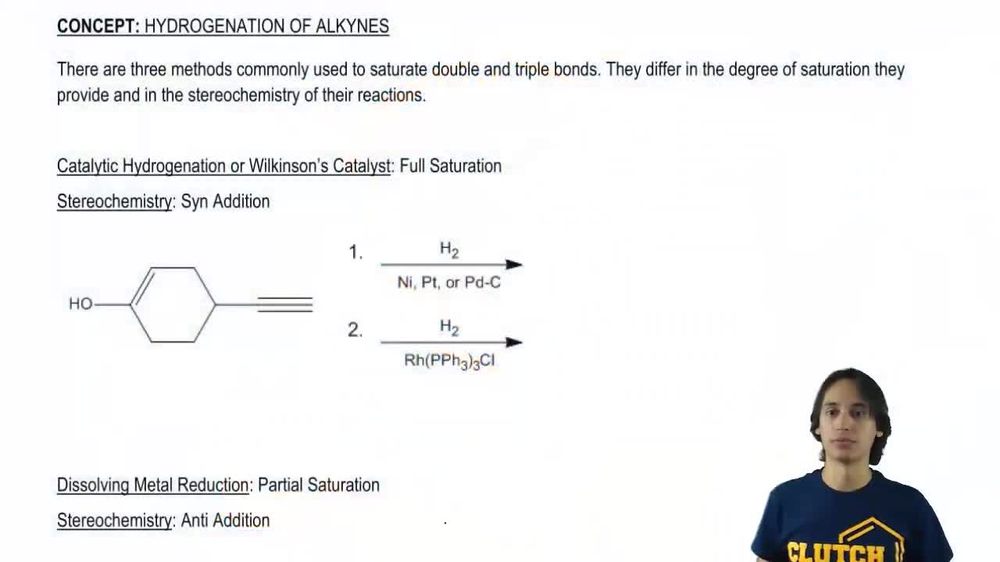
Recall that alkenes are unsaturated hydrocarbons containing at least one double bond. Hydrogenation of an alkene adds H₂ across the double bond, converting it into a saturated alkane.
For part (a), determine all possible alkenes with the molecular formula C₄H₈. Consider different structural isomers, including straight-chain and branched alkenes, as well as positional isomers of the double bond.
For part (b), determine all possible alkenes with the molecular formula C₆H₁₂ that can be hydrogenated to form 3-methylpentane. Focus on structural isomers where the double bond is positioned in a way that hydrogenation results in the correct branching pattern of 3-methylpentane.
Count the total number of unique alkenes for each part, ensuring that stereoisomers (cis/trans or E/Z) are also considered where applicable, as they represent distinct alkenes.
Verified video answer for a similar problem:
This video solution was recommended by our tutors as helpful for the problem above
Video duration:
6m
Play a video:
0 Comments
Key Concepts
Here are the essential concepts you must grasp in order to answer the question correctly.
Alkenes
Alkenes are hydrocarbons that contain at least one carbon-carbon double bond (C=C). They are unsaturated compounds, meaning they have fewer hydrogen atoms than alkanes, which are saturated. The presence of the double bond allows alkenes to undergo various chemical reactions, including hydrogenation, where hydrogen is added across the double bond to form alkanes.
Hydrogenation is a chemical reaction that involves the addition of hydrogen (H2) to an unsaturated compound, such as an alkene, to convert it into a saturated compound, typically an alkane. This reaction is often facilitated by catalysts, such as platinum, palladium, or nickel, and is significant in organic chemistry for modifying the structure and properties of organic molecules.
Structural isomers are compounds that have the same molecular formula but differ in the arrangement of atoms. In the context of alkenes, different structural isomers can lead to various alkenes that can be hydrogenated to yield the same alkane. Understanding structural isomerism is crucial for determining how many distinct alkenes can produce a specific alkane upon hydrogenation.