Draw the products of the following reactions. If the products can exist as stereoisomers, show which stereoisomers are formed. i. (Z)-3,4-dimethyl-3-heptene + H2, Pd/C
Verified step by step guidance
1
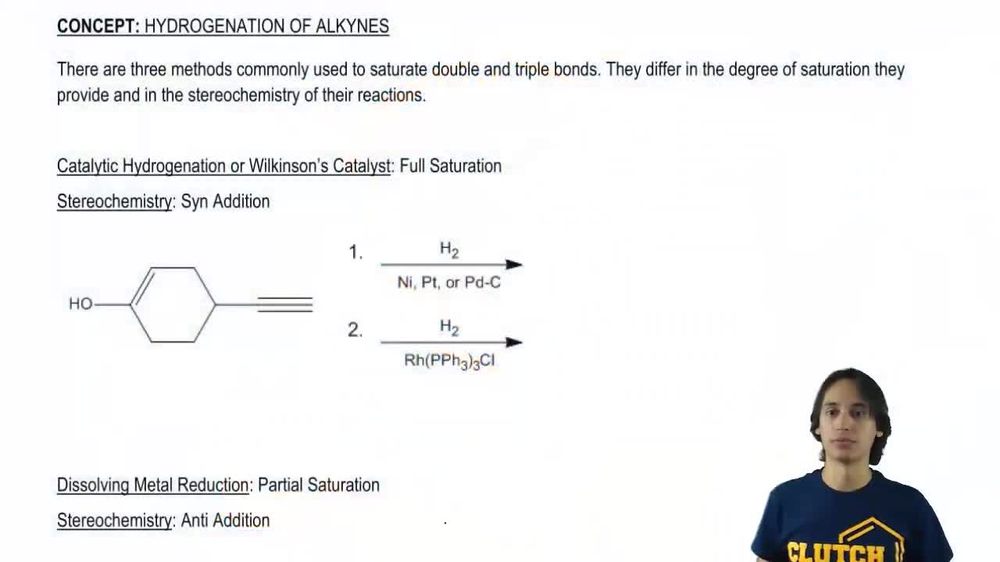
Step 1: Identify the type of reaction taking place. In this case, the reaction involves the addition of hydrogen (H2) in the presence of a palladium catalyst (Pd/C), which is a catalytic hydrogenation reaction. This reaction reduces alkenes to alkanes by breaking the double bond and adding hydrogen atoms.
Step 2: Analyze the structure of the reactant. The reactant is (Z)-3,4-dimethyl-3-heptene, which is an alkene with a double bond between the third and fourth carbons. The (Z) configuration indicates that the two substituents on either side of the double bond are on the same side.
Step 3: Determine the effect of hydrogenation. The double bond in the alkene will be reduced to a single bond, and two hydrogen atoms will be added to the carbons that were part of the double bond. This results in the formation of an alkane.
Step 4: Consider stereochemistry. Since the reaction involves catalytic hydrogenation, the addition of hydrogen occurs on the same face of the molecule (syn addition). However, in this case, the product is an alkane, which does not exhibit stereoisomerism because the double bond is completely removed.
Step 5: Draw the product. The product will be 3,4-dimethylheptane, where the double bond is replaced by a single bond, and the molecule is fully saturated with hydrogen atoms. Ensure that the methyl groups remain attached to the third and fourth carbons as in the original structure.
Verified video answer for a similar problem:
This video solution was recommended by our tutors as helpful for the problem above
Video duration:
3m
Play a video:
0 Comments
Key Concepts
Here are the essential concepts you must grasp in order to answer the question correctly.
Hydrogenation
Hydrogenation is a chemical reaction that involves the addition of hydrogen (H2) to an unsaturated compound, typically alkenes or alkynes, in the presence of a catalyst such as palladium on carbon (Pd/C). This process converts double or triple bonds into single bonds, resulting in saturated hydrocarbons. Understanding hydrogenation is crucial for predicting the products of the reaction involving (Z)-3,4-dimethyl-3-heptene.
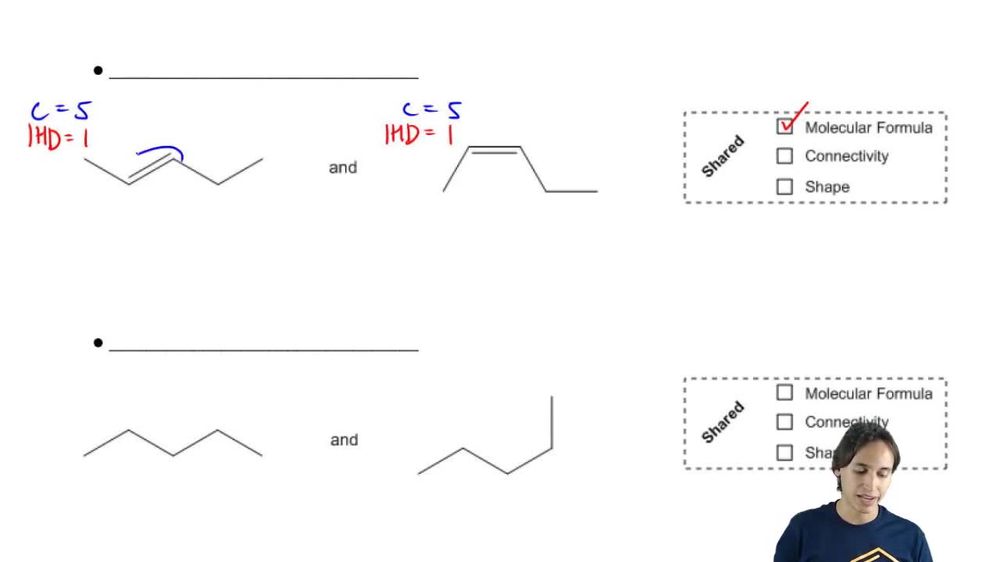
Stereoisomerism refers to the phenomenon where compounds have the same molecular formula and connectivity of atoms but differ in the spatial arrangement of their atoms. In the context of the reaction, the formation of stereoisomers can occur due to the presence of chiral centers or restricted rotation around double bonds. Recognizing potential stereoisomers is essential for accurately depicting the products of the hydrogenation reaction.
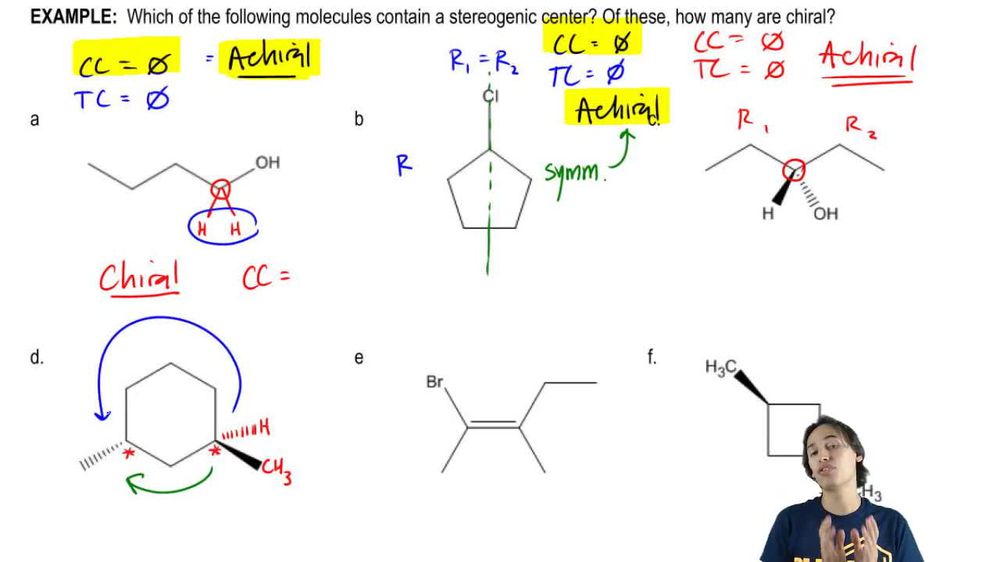
Chirality is a property of a molecule that makes it non-superimposable on its mirror image, often due to the presence of a stereocenter, typically a carbon atom bonded to four different substituents. In the case of (Z)-3,4-dimethyl-3-heptene, the hydrogenation can lead to the formation of chiral products, which can exist as enantiomers. Identifying and representing these stereocenters is vital for understanding the stereochemical outcomes of the reaction.

 3:26 minutes
 Verified step by step guidance
 00:48
00:48