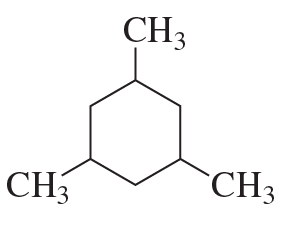
What is the major product obtained from treating an excess of each of the following compounds with Cl2 in the presence of ultraviolet light at room temperature? Disregard stereoisomers. c.
Verified step by step guidance
1
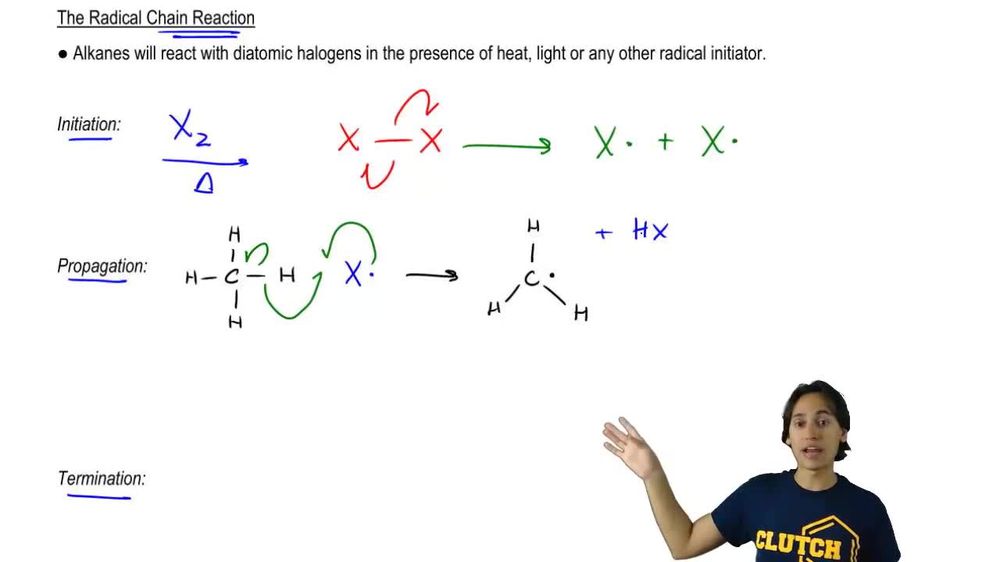
Identify the type of reaction: The reaction involves chlorine (Cl₂) in the presence of ultraviolet (UV) light, which indicates a free radical halogenation reaction. This reaction typically occurs with alkanes or alkyl groups, where hydrogen atoms are replaced by chlorine atoms.
Determine the structure of the starting compound: Analyze the given compound (not specified in the problem text here) to identify the number and types of hydrogens available for substitution. Primary, secondary, and tertiary hydrogens have different reactivities in free radical halogenation.
Understand the reactivity order: In free radical halogenation, tertiary hydrogens are the most reactive, followed by secondary hydrogens, and then primary hydrogens. This is due to the stability of the resulting free radical intermediates.
Account for excess chlorine: Since excess Cl₂ is used, multiple substitutions can occur. This means that all hydrogens on the molecule may be replaced by chlorine atoms, depending on the number of hydrogens and the structure of the compound.
Predict the major product: Based on the structure of the starting compound and the reactivity of the hydrogens, determine the major product(s) formed after all possible substitutions. Disregard stereoisomers as instructed in the problem.
Verified video answer for a similar problem:
This video solution was recommended by our tutors as helpful for the problem above
Video duration:
3m
Play a video:
0 Comments
Key Concepts
Here are the essential concepts you must grasp in order to answer the question correctly.
Free Radical Halogenation
Free radical halogenation is a reaction where alkanes react with halogens (like Cl2) in the presence of heat or light, leading to the substitution of hydrogen atoms with halogen atoms. This process involves the formation of free radicals, which are highly reactive species with unpaired electrons. The reaction typically proceeds through initiation, propagation, and termination steps, resulting in various halogenated products.
Using an excess of a reactant, such as Cl2, influences the reaction outcome by driving the reaction towards the formation of more halogenated products. In free radical halogenation, an excess of Cl2 can lead to multiple substitutions on the alkane, resulting in a major product that is heavily halogenated. This concept is crucial for predicting the major product in reactions where the halogen can replace multiple hydrogen atoms.
Ultraviolet (UV) light serves as a source of energy that initiates the free radical halogenation process by breaking the Cl-Cl bond in chlorine molecules, generating chlorine radicals. This initiation step is essential for the reaction to proceed, as it creates the reactive species needed for the substitution of hydrogen atoms in alkanes. Understanding the role of UV light helps in grasping how the reaction conditions affect product formation.