What hydrocarbon with molecular formula C4H10 forms only two monochlorinated products? Both products are achiral.
Verified step by step guidance
1
Step 1: Begin by analyzing the molecular formula C4H10. This formula corresponds to an alkane, as it follows the general formula CnH2n+2 for saturated hydrocarbons.
Step 2: Recognize that the problem asks for a hydrocarbon that forms only two monochlorinated products. This implies that the molecule must have only two types of equivalent hydrogen atoms that can be substituted by chlorine.
Step 3: Consider the possible isomers of C4H10. There are two structural isomers: n-butane (a straight-chain alkane) and isobutane (a branched alkane). Evaluate each isomer for the number of unique hydrogen environments.
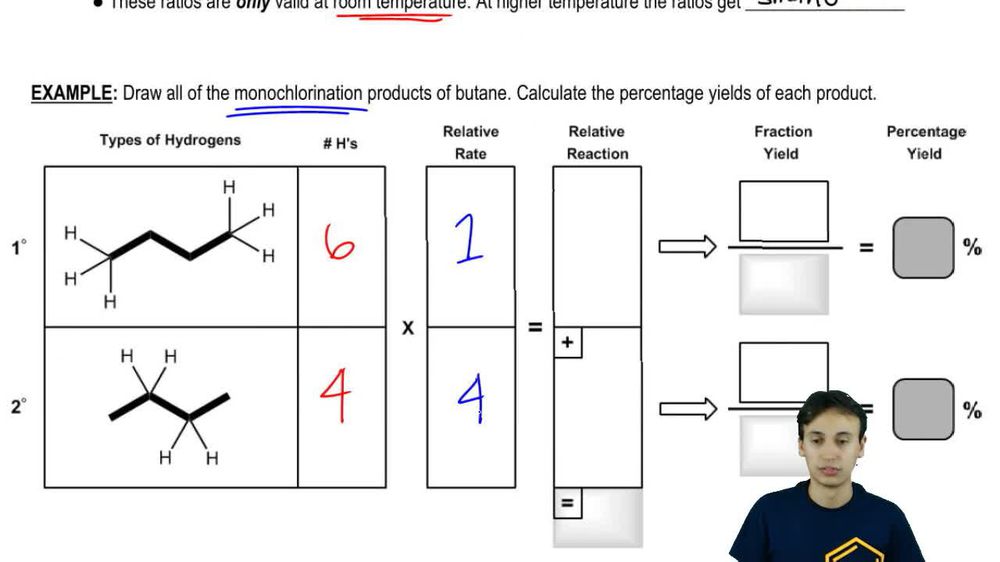
Step 4: For n-butane, there are two types of hydrogen environments: primary hydrogens (on the terminal carbons) and secondary hydrogens (on the internal carbons). Chlorination of n-butane would result in two distinct monochlorinated products, both of which are achiral.
Step 5: For isobutane, there are also two types of hydrogen environments: primary hydrogens (on the three equivalent methyl groups) and a tertiary hydrogen (on the central carbon). Chlorination of isobutane would also result in two distinct monochlorinated products, but one of them would be chiral. Therefore, the correct hydrocarbon is n-butane.
Verified video answer for a similar problem:
This video solution was recommended by our tutors as helpful for the problem above
Video duration:
4m
Play a video:
0 Comments
Key Concepts
Here are the essential concepts you must grasp in order to answer the question correctly.
Hydrocarbons
Hydrocarbons are organic compounds consisting entirely of hydrogen and carbon atoms. They can be classified into aliphatic (alkanes, alkenes, alkynes) and aromatic hydrocarbons. The molecular formula C4H10 indicates an alkane, specifically butane, which can undergo substitution reactions, such as chlorination, to form chlorinated derivatives.
Monochlorination refers to the substitution reaction where one hydrogen atom in a hydrocarbon is replaced by a chlorine atom. For alkanes, this process can yield multiple products depending on the number of unique hydrogen atoms available for substitution. In the case of C4H10, the presence of symmetrical structures leads to only two distinct monochlorinated products.
Draw all of the monochlorination products and calculate percentage yields.
Chirality
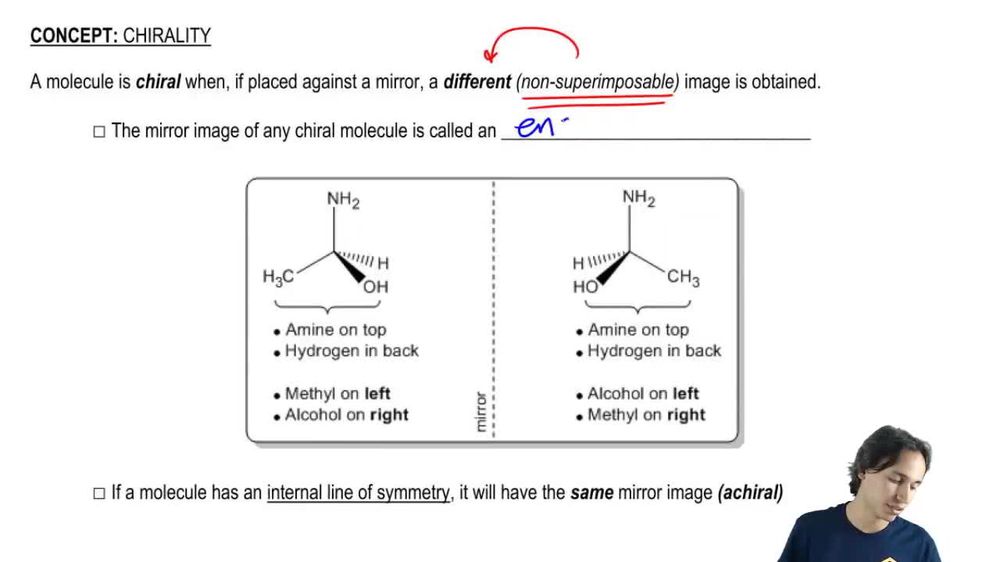
Chirality is a property of a molecule that makes it non-superimposable on its mirror image, often due to the presence of a chiral center (a carbon atom bonded to four different groups). Achiral molecules, on the other hand, have symmetry and do not exhibit this property. The question specifies that both monochlorinated products are achiral, indicating that the substitution occurs at positions that do not create chiral centers.

 4:08 minutes
 Verified step by step guidance
 04:52
04:52