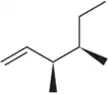
Predict the product(s) that would result when the alkenes are allowed to react under the following conditions: (ix) H2, Pd/C; (d)
Verified step by step guidance
1
Step 1: Recognize the type of reaction. The reaction involves an alkene reacting with hydrogen gas (H₂) in the presence of a palladium catalyst on carbon (Pd/C). This is a catalytic hydrogenation reaction, which reduces alkenes to alkanes by adding hydrogen across the double bond.
Step 2: Identify the structure of the alkene. Determine the location of the double bond in the alkene molecule, as this is where the hydrogen atoms will be added.
Step 3: Understand the stereochemistry of the reaction. Catalytic hydrogenation typically results in syn addition, meaning both hydrogen atoms are added to the same face of the double bond. This can affect the stereochemistry of the product if the alkene is part of a cyclic or chiral structure.
Step 4: Write the product structure. Replace the double bond in the alkene with a single bond and add one hydrogen atom to each of the two carbons that were part of the double bond. Ensure the correct stereochemistry is represented if applicable.
Step 5: Verify the product. Check that the resulting molecule is fully saturated (contains no double bonds) and confirm that the addition of hydrogen atoms has been done correctly according to the reaction mechanism.
Verified video answer for a similar problem:
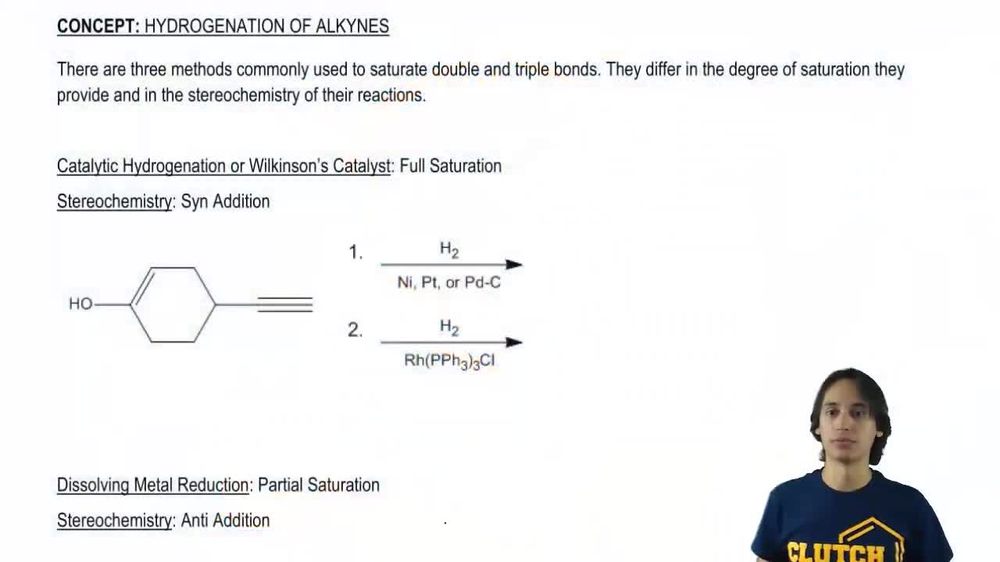
This video solution was recommended by our tutors as helpful for the problem above
Video duration:
3m
Play a video:
0 Comments
Key Concepts
Here are the essential concepts you must grasp in order to answer the question correctly.
Hydrogenation
Hydrogenation is a chemical reaction that involves the addition of hydrogen (H₂) to an unsaturated compound, such as an alkene or alkyne, resulting in the formation of a saturated compound. This reaction typically requires a catalyst, such as palladium on carbon (Pd/C), which facilitates the breaking of the double bond in the alkene and the addition of hydrogen atoms.
Alkenes are hydrocarbons that contain at least one carbon-carbon double bond (C=C). They are unsaturated compounds, meaning they have fewer hydrogen atoms than alkanes, which are fully saturated. The presence of the double bond makes alkenes more reactive than alkanes, allowing them to undergo various addition reactions, including hydrogenation.
Catalysis is the process by which a catalyst increases the rate of a chemical reaction without being consumed in the process. In the context of hydrogenation, palladium on carbon (Pd/C) serves as a catalyst that lowers the activation energy required for the reaction, allowing the addition of hydrogen to alkenes to occur more efficiently and under milder conditions.