Predict the products formed when CH3CH2–C≡C:–Na+ reacts with the following compounds. (d) cyclohexanone (e) CH3CH2CH2CHO
Verified step by step guidance
1
Step 1: Analyze the given reactants. Cyclohexanone is a ketone with a six-membered ring, and CH3CH2CH2CHO is an aldehyde. Both compounds contain carbonyl groups (C=O), which are reactive functional groups in organic chemistry.
Step 2: Determine the type of reaction that might occur. Carbonyl compounds like ketones and aldehydes are often involved in nucleophilic addition reactions, condensation reactions, or oxidation/reduction reactions depending on the reagents and conditions.
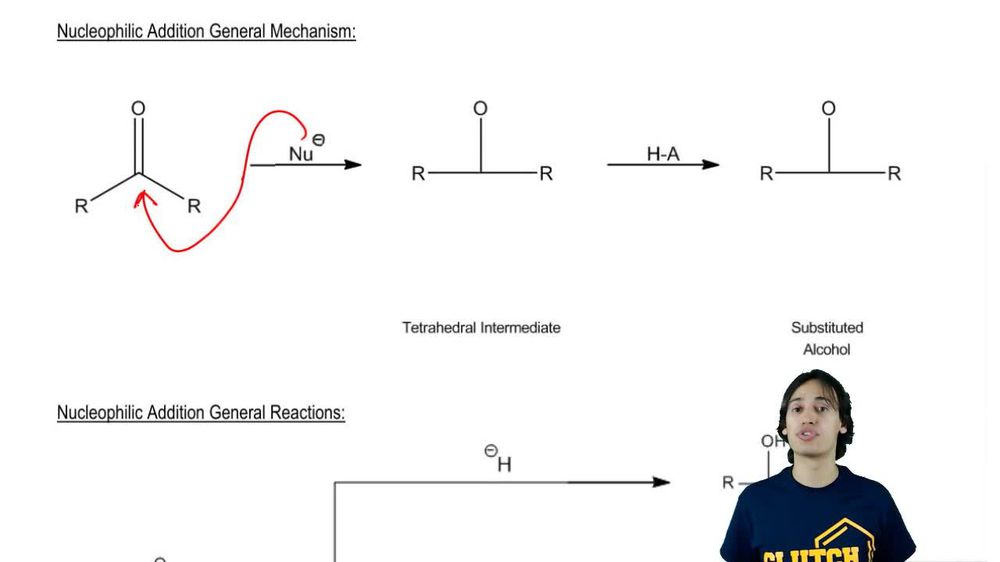
Step 3: Consider the reactivity of the carbonyl group. The carbon atom in the carbonyl group is electrophilic due to the polarization of the C=O bond, making it susceptible to attack by nucleophiles. Cyclohexanone and CH3CH2CH2CHO will react differently based on their structural differences (ketone vs. aldehyde).
Step 4: Predict the interaction between the given reactants and the compounds. For cyclohexanone, reactions such as aldol condensation or nucleophilic addition could occur depending on the conditions. For CH3CH2CH2CHO, similar reactions are possible, but aldehydes are generally more reactive than ketones due to less steric hindrance and greater electrophilicity.
Step 5: Write the general mechanism for the reaction. For example, if a nucleophile attacks the carbonyl carbon, the double bond in the C=O group will break, forming a tetrahedral intermediate. Depending on the reaction conditions, this intermediate may lead to the formation of a new product, such as an alcohol or a condensation product.
Verified video answer for a similar problem:
This video solution was recommended by our tutors as helpful for the problem above
Video duration:
5m
Play a video:
0 Comments
Key Concepts
Here are the essential concepts you must grasp in order to answer the question correctly.
Nucleophilic Addition
Nucleophilic addition is a fundamental reaction mechanism in organic chemistry where a nucleophile attacks an electrophilic carbon atom, typically found in carbonyl compounds like ketones and aldehydes. This process leads to the formation of a new bond and is crucial for predicting the products of reactions involving compounds such as cyclohexanone and aldehydes.
Carbonyl compounds, which include aldehydes and ketones, contain a carbon-oxygen double bond (C=O). Their reactivity is largely due to the polarization of the carbonyl bond, making the carbon atom electrophilic and susceptible to nucleophilic attack. Understanding the structure and reactivity of these compounds is essential for predicting the outcomes of reactions.
Reaction mechanisms describe the step-by-step process by which reactants transform into products. In the context of organic reactions, understanding the mechanism helps in predicting the products formed, including intermediates and transition states. This knowledge is vital for analyzing the reactions of cyclohexanone and other compounds with nucleophiles.