Ch. 16 - Reactions of Aldehydes and Ketones • More Reactions of Carboxylic Acid Derivatives
Bruice - Organic Chemistry 8th Edition
Bruice8th EditionOrganic ChemistryISBN: 9780135213711Not the one you use?Change textbook
Chapter 17, Problem 27

A ketone can be prepared from the reaction of a nitrile with a Grignard reagent. Describe the intermediate formed in this reaction, and show how it can be converted to a ketone.

Verified step by step guidance
1
The reaction begins with the nucleophilic attack of the Grignard reagent (R-MgX) on the carbon atom of the nitrile group (R'-C≡N). This carbon is electrophilic due to the polarization of the triple bond between carbon and nitrogen.
The nucleophilic attack results in the formation of an intermediate imine salt. The structure of this intermediate can be represented as R'-C=N⁻-MgX, where the nitrogen atom carries a negative charge and is bonded to the magnesium ion.
The imine salt intermediate is then hydrolyzed in the presence of water or an acidic workup. During hydrolysis, the imine group (C=N⁻) is converted into a carbonyl group (C=O).
The hydrolysis step involves protonation of the nitrogen atom, followed by the cleavage of the C=N bond and the addition of water to form a ketone (R'-C=O-R).
The final product of the reaction is a ketone, where the alkyl group from the Grignard reagent (R) is attached to the carbonyl carbon of the original nitrile (R'-C≡N).

Verified video answer for a similar problem:

This video solution was recommended by our tutors as helpful for the problem above.
Video duration:
2m
Was this helpful?

Key Concepts

Here are the essential concepts you must grasp in order to answer the question correctly.

Grignard Reagents

Grignard reagents are organomagnesium compounds that act as nucleophiles in organic reactions. They are formed by the reaction of an alkyl or aryl halide with magnesium metal in anhydrous ether. In the context of the reaction with nitriles, Grignard reagents attack the electrophilic carbon of the nitrile, leading to the formation of a new carbon-carbon bond.
Recommended video:
Guided course
02:12
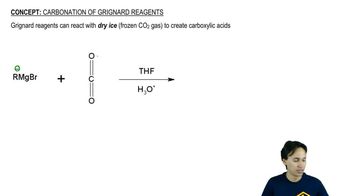
Carbonation of Grignard Reagents

Nitrile Intermediate

When a Grignard reagent reacts with a nitrile, it forms an intermediate known as an imine or a ketimine, depending on the structure of the nitrile. This intermediate contains a carbon-nitrogen double bond and is crucial for the subsequent transformation into a ketone. The imine can be hydrolyzed to yield the corresponding ketone upon treatment with water or an acid.
Recommended video:
Guided course
01:01
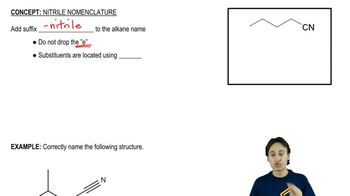
Nitrile Nomenclature

Hydrolysis of Imines

Hydrolysis of imines involves the addition of water to the imine intermediate, leading to the cleavage of the carbon-nitrogen double bond. This reaction typically requires an acid catalyst to facilitate the process. The result is the formation of a ketone and the release of ammonia, completing the conversion from the nitrile to the ketone through the imine intermediate.
Recommended video:
Guided course
06:23
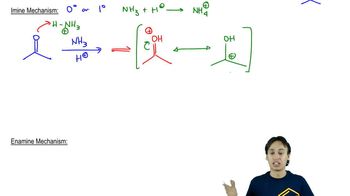
Imine Mechanism