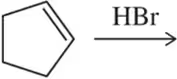
Predict the product(s) of each of the following reactions. If you expect a racemic mixture, draw both enantiomers. (c)
Verified step by step guidance
1
Identify the type of reaction: The reaction involves HBr, which suggests a hydrohalogenation reaction, typically adding H and Br across a double bond in an alkene.
Determine the structure of the starting material: Since the problem does not specify, assume a generic alkene structure. The double bond will be the site of reaction.
Apply Markovnikov's rule: In hydrohalogenation, the hydrogen atom from HBr will add to the less substituted carbon of the double bond, while the bromine atom will add to the more substituted carbon.
Consider the formation of a carbocation intermediate: The addition of H+ to the alkene forms a carbocation. Ensure that the most stable carbocation is formed, which is typically the more substituted one.
Predict the product: The final product will be an alkyl bromide, with the bromine atom attached to the more substituted carbon. If the starting alkene is symmetrical, a single product is formed. If asymmetrical, consider the possibility of a racemic mixture if a chiral center is created.
Verified video answer for a similar problem:
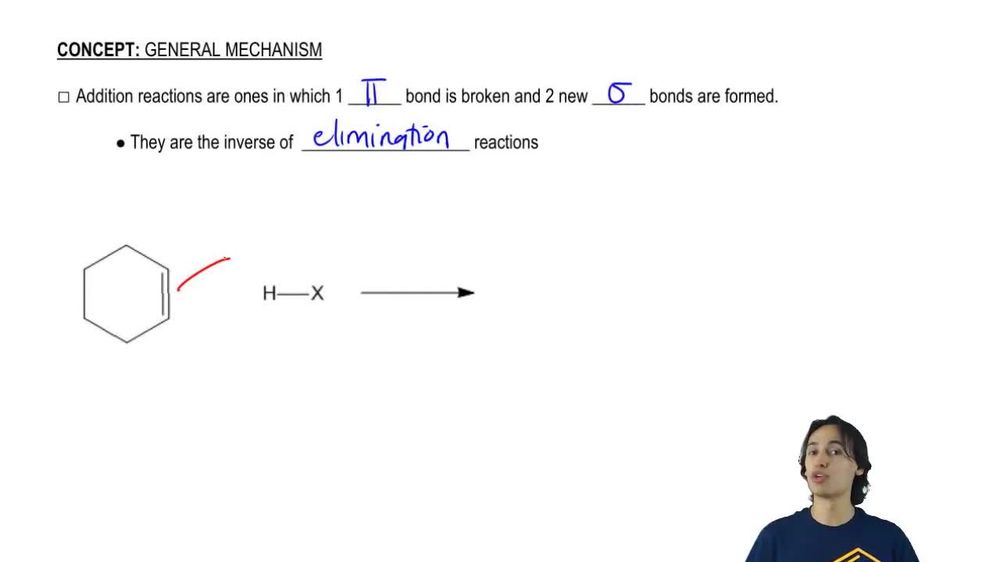
This video solution was recommended by our tutors as helpful for the problem above
Video duration:
2m
Play a video:
0 Comments
Key Concepts
Here are the essential concepts you must grasp in order to answer the question correctly.
Electrophilic Addition Reaction
Electrophilic addition is a reaction where an electrophile reacts with a nucleophile, typically involving alkenes or alkynes. In the presence of HBr, the π bond of an alkene acts as a nucleophile, attacking the electrophilic hydrogen, leading to the formation of a carbocation intermediate, which then reacts with the bromide ion to form the final product.
Markovnikov's Rule predicts the regiochemistry of electrophilic addition reactions, stating that the hydrogen atom will add to the less substituted carbon of the double bond, while the halide (bromine in this case) will add to the more substituted carbon. This rule helps determine the major product in reactions involving unsymmetrical alkenes.
A racemic mixture consists of equal amounts of two enantiomers, which are mirror images of each other. In reactions where a chiral center is formed, such as the addition of HBr to an alkene, if the reaction does not favor one enantiomer over the other, a racemic mixture is produced, resulting in no optical activity.