Ch. 7 - Structure and Synthesis of Alkenes; Elimination
Wade - Organic Chemistry 9th Edition
Wade9th EditionOrganic ChemistryISBN: 9780135213728Not the one you use?Change textbook
Chapter 7, Problem 64b

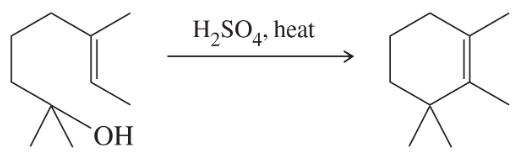
Protonation converts the hydroxy group of an alcohol to a good leaving group. Suggest a mechanism for each reaction.
(b)

Verified step by step guidance
1
Step 1: Protonation of the alcohol group - The hydroxyl group (-OH) of the alcohol is protonated by sulfuric acid (H2SO4), converting it into a better leaving group (water, H2O). This occurs because the acidic environment provides a proton (H+), which attaches to the oxygen atom of the hydroxyl group.
Step 2: Formation of a carbocation - After protonation, the water molecule leaves, generating a carbocation intermediate. The stability of the carbocation is crucial, and in this case, the tertiary carbocation is formed due to the presence of three alkyl groups attached to the carbon, which stabilize the positive charge through hyperconjugation and inductive effects.
Step 3: Rearrangement of the carbocation - If necessary, the carbocation may undergo rearrangement to form a more stable carbocation. In this case, no rearrangement is needed as the tertiary carbocation is already highly stable.
Step 4: Elimination reaction - Heat promotes the elimination of a proton from a β-carbon (a carbon adjacent to the carbocation). This elimination leads to the formation of a double bond (alkene) in the product. The most stable alkene is formed, following Zaitsev's rule, which states that the more substituted alkene is favored.
Step 5: Final product formation - The reaction results in the formation of the cyclic alkene product, where the double bond is positioned in the most stable configuration within the ring structure.

Verified video answer for a similar problem:

This video solution was recommended by our tutors as helpful for the problem above.
Video duration:
3m
Was this helpful?

Key Concepts

Here are the essential concepts you must grasp in order to answer the question correctly.

Protonation of Alcohols

Protonation is the addition of a proton (H+) to a molecule, which in the case of alcohols, converts the hydroxy (-OH) group into a better leaving group, water (H2O). This process enhances the electrophilicity of the carbon atom bonded to the hydroxy group, facilitating subsequent reactions such as elimination or substitution.
Recommended video:
Guided course
01:01
How to name alcohols

Elimination Reactions

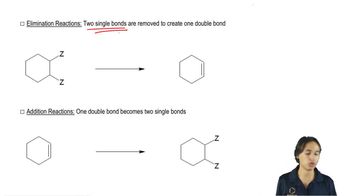
Elimination reactions involve the removal of a small molecule from a larger one, typically resulting in the formation of a double bond. In the context of alcohols, after protonation, the leaving group departs, and a β-hydrogen is often removed, leading to the formation of alkenes. This is a key step in dehydration reactions, commonly catalyzed by acids like sulfuric acid.
Recommended video:
Guided course
00:40
Recognizing Elimination Reactions.

Mechanism of Acid-Catalyzed Reactions

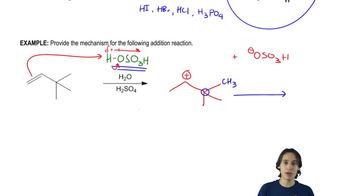
The mechanism of acid-catalyzed reactions typically involves multiple steps, including protonation, formation of a carbocation, and elimination. In the provided reaction, sulfuric acid protonates the alcohol, forming a carbocation intermediate, which then undergoes elimination to yield an alkene. Understanding this mechanism is crucial for predicting the products and the reaction pathway.
Recommended video:
Guided course
06:34
Acid-catalyzed hydration mechanism
Related Practice
Textbook Question

Silver-assisted solvolysis of bromomethylcyclopentane in methanol gives a complex product mixture of the following five compounds. Propose mechanisms to account for these products.

(e)

230
views

Textbook Question

a. Design an alkyl halide that will give only 2,4-diphenylpent-2-ene upon treatment with potassium tert-butoxide (a bulky base that promotes E2 elimination).

b. What stereochemistry is required in your alkyl halide so that only the following stereoisomer of the product is formed?

845
views
Textbook Question

A chemist allows some pure (2S,3R)-3-bromo-2,3-diphenylpentane to react with a solution of sodium ethoxide (NaOCH2CH3) in ethanol. The products are two alkenes: A (cis-trans mixture) and B, a single pure isomer. Under the same conditions, the reaction of (2S,3S)-3-bromo-2,3-diphenylpentane gives two alkenes, A (cis-trans mixture) and C. Upon catalytic hydrogenation, all three of these alkenes (A, B, and C) give 2,3-diphenylpentane. Determine the structures of A, B, and C; give equations for their formation; and explain the stereospecificity of these reactions.

1654
views
Textbook Question

Pure (S)-2-bromo-2-fluorobutane reacts with methoxide ion in methanol to give a mixture of (S)-2-fluoro-2-methoxybutane and three fluoroalkenes.

a. Use mechanisms to show which three fluoroalkenes are formed.

2163
views
Textbook Question

Silver-assisted solvolysis of bromomethylcyclopentane in methanol gives a complex product mixture of the following five compounds. Propose mechanisms to account for these products.

(d)

250
views
Textbook Question

Protonation converts the hydroxy group of an alcohol to a good leaving group. Suggest a mechanism for each reaction.

(a)

998
views