Ch. 6 - The Reactions of Alkenes • The Stereochemistry of Addition Reactions
Bruice - Organic Chemistry 8th Edition
Bruice8th EditionOrganic ChemistryISBN: 9780135213711Not the one you use?Change textbook
Chapter 7, Problem 23b

Each of the following reactions has two nucleophiles that could add to the intermediate formed by the reaction of the alkene with an electrophile. What is the major product of each reaction?
b. Chemical equation showing the reaction of propene with sodium iodide and hydrogen bromide to form a product.

Verified step by step guidance
1
Step 1: Analyze the reactants. The alkene (CH2═CHCH3) is the nucleophile, HBr is the electrophile, and NaI provides iodide ions (I⁻) as a potential nucleophile.
Step 2: The reaction begins with the electrophilic addition of HBr to the alkene. The π-electrons of the double bond attack the hydrogen atom of HBr, forming a carbocation intermediate. The regioselectivity follows Markovnikov's rule, where the hydrogen adds to the less substituted carbon, and the bromine adds to the more substituted carbon.
Step 3: The carbocation intermediate formed is CH3-CH⁺-CH3 (a secondary carbocation). This intermediate is susceptible to nucleophilic attack by either Br⁻ or I⁻.
Step 4: Consider the nucleophiles. Br⁻ is generated from HBr, and I⁻ is provided by NaI. I⁻ is a stronger nucleophile than Br⁻ due to its larger size and higher polarizability, so it preferentially attacks the carbocation.
Step 5: The major product is formed by the addition of I⁻ to the carbocation, resulting in CH3-CHI-CH3. The minor product would involve Br⁻ attacking the carbocation, forming CH3-CHBr-CH3.

Verified video answer for a similar problem:

This video solution was recommended by our tutors as helpful for the problem above.
Video duration:
4m
Was this helpful?

Key Concepts

Here are the essential concepts you must grasp in order to answer the question correctly.

Electrophilic Addition

Electrophilic addition is a fundamental reaction mechanism in organic chemistry where an electrophile reacts with a nucleophile, typically involving alkenes. In this process, the double bond of the alkene acts as a nucleophile, attacking the electrophile, leading to the formation of a more stable carbocation intermediate. This step is crucial for understanding how different nucleophiles can subsequently add to the intermediate.
Recommended video:
Guided course
09:23
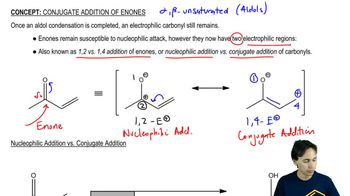
1,2 vs 1,4 Addition

Nucleophiles

Nucleophiles are species that donate an electron pair to form a chemical bond in a reaction. In the context of the given reaction, both NaI and HBr can act as nucleophiles after the electrophilic addition of HBr to the alkene. Understanding the nature of nucleophiles, including their strength and reactivity, is essential for predicting the major product of the reaction.
Recommended video:
Guided course
08:27
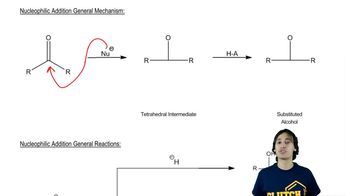
Nucleophilic Addition

Regioselectivity

Regioselectivity refers to the preference of a chemical reaction to yield one structural isomer over others when multiple possibilities exist. In the reaction of propene with HBr, the formation of a carbocation can lead to different products depending on which nucleophile attacks the carbocation. Recognizing the regioselectivity helps in determining the major product based on the stability of the intermediates formed during the reaction.
Recommended video:
Guided course
05:09
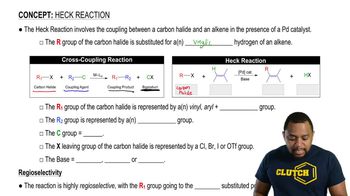
Heck Reaction