Ch. 16 - Reactions of Aldehydes and Ketones • More Reactions of Carboxylic Acid Derivatives
Bruice - Organic Chemistry 8th Edition
Bruice8th EditionOrganic ChemistryISBN: 9780135213711Not the one you use?Change textbook
Chapter 17, Problem 71

Rank the following compounds from most reactive to least reactive toward nucleophilic addition:
Four chemical structures are displayed, showing various compounds for ranking their reactivity toward nucleophilic addition.

Verified step by step guidance
1
Identify the functional groups present in each compound. Nucleophilic addition reactions typically occur at carbonyl groups (C=O), so focus on compounds containing aldehydes, ketones, esters, or other carbonyl-containing groups.
Consider the electronic effects of substituents attached to the carbonyl carbon. Electron-withdrawing groups (e.g., halogens, nitro groups) increase the electrophilicity of the carbonyl carbon, making it more reactive toward nucleophiles. Electron-donating groups (e.g., alkyl groups) decrease electrophilicity, reducing reactivity.
Evaluate steric hindrance around the carbonyl carbon. Compounds with less steric hindrance (e.g., aldehydes) are generally more reactive than those with more steric hindrance (e.g., ketones or bulky esters).
Rank the compounds based on the combined effects of electronic and steric factors. Aldehydes are typically more reactive than ketones, which are more reactive than esters or amides. Within each category, consider the specific substituents to refine the ranking.
Verify the ranking by considering resonance effects or other stabilizing interactions that might influence the reactivity of the carbonyl group. For example, conjugation with an aromatic ring can reduce reactivity by delocalizing the positive charge on the carbonyl carbon.

Verified video answer for a similar problem:

This video solution was recommended by our tutors as helpful for the problem above.
Video duration:
4m
Was this helpful?

Key Concepts

Here are the essential concepts you must grasp in order to answer the question correctly.

Nucleophilic Addition

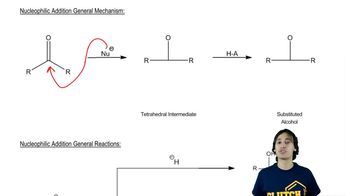
Nucleophilic addition is a fundamental reaction in organic chemistry where a nucleophile attacks an electrophilic carbon atom, typically in carbonyl compounds. This process is crucial for forming new bonds and is influenced by the electrophilicity of the carbonyl carbon, which is affected by the substituents attached to it. Understanding the mechanism and factors that enhance or diminish reactivity is essential for ranking compounds.
Recommended video:
Guided course
08:27
Nucleophilic Addition

Electrophilicity

Electrophilicity refers to the tendency of a molecule to attract electrons, making it susceptible to nucleophilic attack. In the context of carbonyl compounds, the presence of electron-withdrawing groups increases the electrophilicity of the carbonyl carbon, enhancing its reactivity. Conversely, electron-donating groups can decrease electrophilicity, making the compound less reactive toward nucleophiles.
Recommended video:
Guided course
03:
Nucleophile or Electrophile

Steric Hindrance

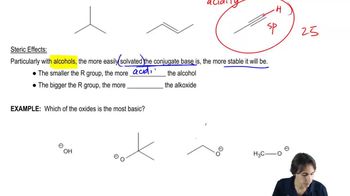
Steric hindrance is the repulsion that occurs when atoms are brought close together, which can impede the approach of nucleophiles to the electrophilic center. In nucleophilic addition reactions, bulky substituents around the carbonyl group can create steric barriers, reducing the reactivity of the compound. Evaluating steric effects is crucial when ranking compounds based on their reactivity toward nucleophilic addition.
Recommended video:
Guided course
02:53
Understanding steric effects.