Ch. 1 - Remembering General Chemistry: Electronic Structure and Bonding (Part 1)
Bruice - Organic Chemistry 8th Edition
Bruice8th EditionOrganic ChemistryISBN: 9780135213711Not the one you use?Change textbook
Chapter 1, Problem 2

a. How many protons do the following species have?
b. How many electrons does each have?
  1. Na+
  2. Ar
  3. Cl-

Verified step by step guidance
1
Step 1: Identify the atomic number of each element using the periodic table. The atomic number represents the number of protons in a neutral atom. For example, Sodium (Na) has an atomic number of 11, Argon (Ar) has an atomic number of 18, and Chlorine (Cl) has an atomic number of 17.
Step 2: Determine the number of protons for each species. Since the atomic number equals the number of protons, Na+ has 11 protons, Ar has 18 protons, and Cl- has 17 protons.
Step 3: Analyze the charge of each species to determine the number of electrons. A neutral atom has the same number of electrons as protons. For charged species, adjust the electron count based on the charge. For Na+, the positive charge indicates it has lost one electron, so it has 10 electrons. For Ar, it is neutral, so it has 18 electrons. For Cl-, the negative charge indicates it has gained one electron, so it has 18 electrons.
Step 4: Summarize the findings for each species: Na+ has 11 protons and 10 electrons, Ar has 18 protons and 18 electrons, and Cl- has 17 protons and 18 electrons.
Step 5: Verify the results by ensuring the charge of each species matches the difference between the number of protons and electrons. For Na+, 11 protons - 10 electrons = +1 charge. For Ar, 18 protons - 18 electrons = 0 charge. For Cl-, 17 protons - 18 electrons = -1 charge.

Verified video answer for a similar problem:

This video solution was recommended by our tutors as helpful for the problem above.
Video duration:
5m
Was this helpful?

Key Concepts

Here are the essential concepts you must grasp in order to answer the question correctly.

Atomic Structure

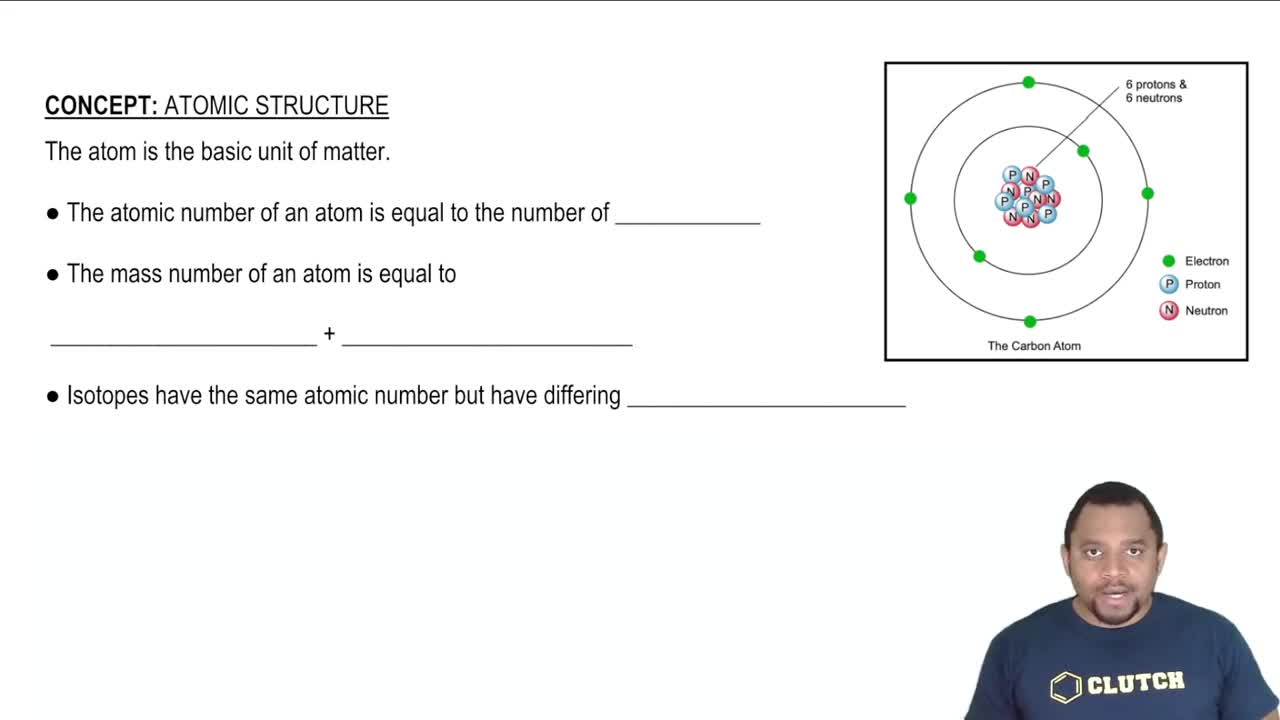
Atomic structure refers to the composition of an atom, which includes protons, neutrons, and electrons. Protons are positively charged particles found in the nucleus, while electrons are negatively charged and orbit the nucleus. The number of protons defines the atomic number and the identity of the element, while the number of electrons determines the atom's charge and reactivity.
Recommended video:
Guided course
01:44
The difference between atomic numbers and atomic mass.

Ionic Charge

Ionic charge is the electrical charge that an atom or molecule carries due to the loss or gain of electrons. For example, a sodium ion (Na+) has lost one electron, resulting in a positive charge, while a chloride ion (Cl-) has gained one electron, resulting in a negative charge. Understanding ionic charges is crucial for determining the number of electrons in an ion compared to its neutral atom.
Recommended video:
Guided course
01:34
Calculating formal and net charge.

Periodic Table

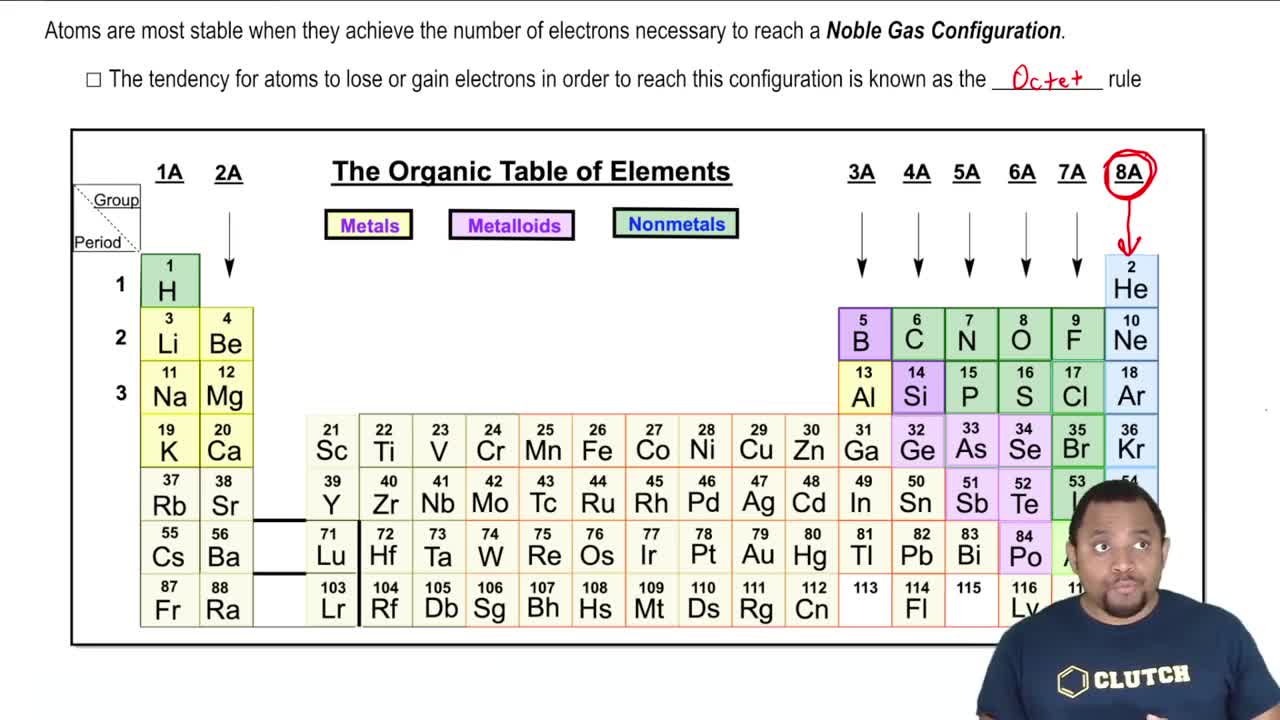
The periodic table is a tabular arrangement of elements organized by increasing atomic number, which corresponds to the number of protons in an atom. Each element's position provides information about its properties, including its atomic mass and electron configuration. The periodic table is essential for quickly identifying the number of protons and electrons in various elements and ions.
Recommended video:
Guided course
02:24
The most important parts of the periodic table for organic chemistry