Oxygen has three isotopes, 16O, 17O, and 18O. The atomic number of oxygen is 8. How many protons and neutrons does each of the isotopes have?
Ch. 1 - Remembering General Chemistry: Electronic Structure and Bonding (Part 1)
All textbooks
Bruice 8th Edition
Ch. 1 - Remembering General Chemistry: Electronic Structure and Bonding (Part 1)
Problem 4a,b
Bruice 8th Edition
Ch. 1 - Remembering General Chemistry: Electronic Structure and Bonding (Part 1)
Problem 4a,bChapter 1, Problem 4a,b
How many valence electrons do the following atoms have?
a. boron
b. nitrogen
Verified step by step guidance1
Step 1: Recall the concept of valence electrons. Valence electrons are the electrons in the outermost shell of an atom that are involved in chemical bonding. The number of valence electrons can be determined from the atom's position in the periodic table.
Step 2: Locate boron on the periodic table. Boron is in Group 13 (or Group IIIA in older notation). Elements in Group 13 have 3 valence electrons because their electron configuration ends in ns²np¹.
Step 3: Locate nitrogen on the periodic table. Nitrogen is in Group 15 (or Group VA in older notation). Elements in Group 15 have 5 valence electrons because their electron configuration ends in ns²np³.
Step 4: Write the electron configurations for boron and nitrogen to confirm the number of valence electrons. For boron, the configuration is 1s²2s²2p¹, and for nitrogen, it is 1s²2s²2p³. The electrons in the 2s and 2p orbitals are the valence electrons.
Step 5: Summarize the findings: Boron has 3 valence electrons, and nitrogen has 5 valence electrons. This information is crucial for understanding their chemical reactivity and bonding behavior.

Verified video answer for a similar problem:
This video solution was recommended by our tutors as helpful for the problem above.
Video duration:
1mWas this helpful?
Key Concepts
Here are the essential concepts you must grasp in order to answer the question correctly.
Valence Electrons
Valence electrons are the outermost electrons of an atom and are crucial for determining how an atom interacts with others. They play a key role in chemical bonding, as they are involved in the formation of bonds between atoms. The number of valence electrons can often be determined by an element's position in the periodic table.
Recommended video:
Guided course
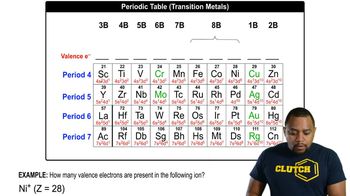
Valence Electrons of Transition Metals
Periodic Table
The periodic table organizes elements based on their atomic number and electron configuration. Elements in the same group (column) typically have the same number of valence electrons, which influences their chemical properties. Understanding the layout of the periodic table helps predict the behavior of elements during chemical reactions.
Recommended video:
Guided course
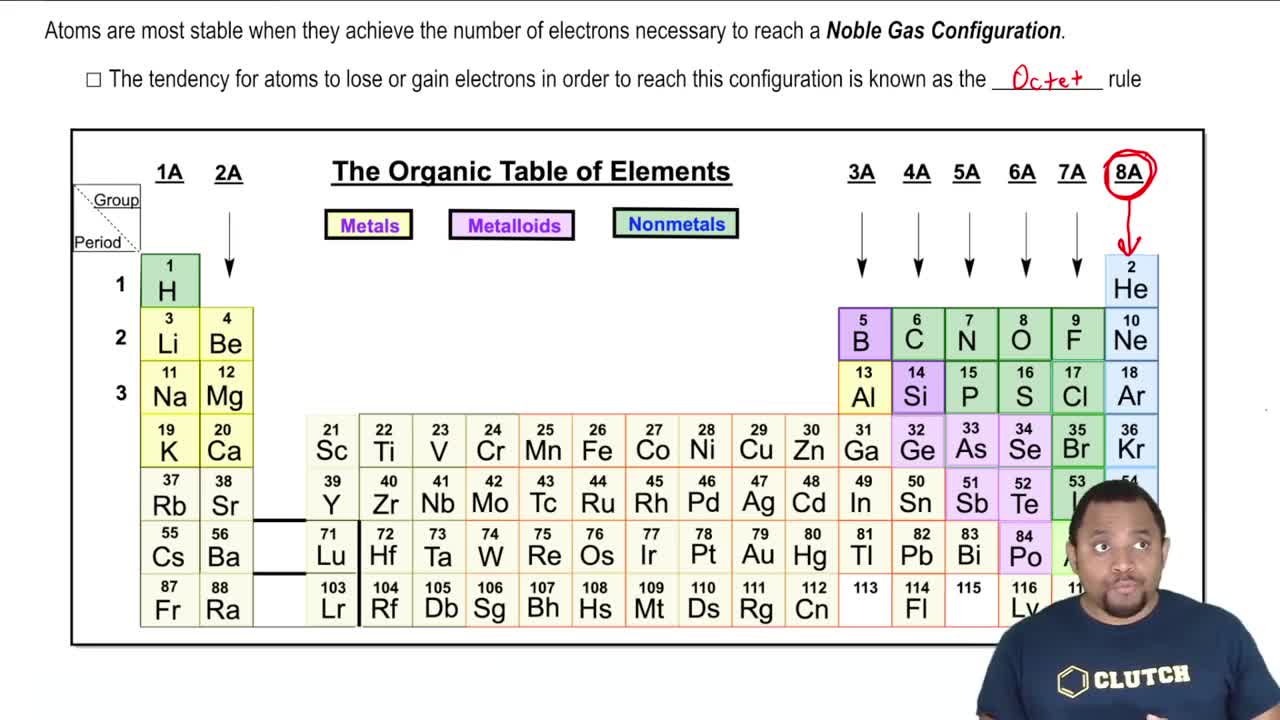
The most important parts of the periodic table for organic chemistry
Electron Configuration
Electron configuration describes the distribution of electrons in an atom's orbitals. For main group elements, the valence electrons are found in the outermost s and p orbitals. Knowing the electron configuration allows one to determine the number of valence electrons, which is essential for understanding an element's reactivity and bonding capabilities.
Recommended video:
Guided course
The Electron Configuration
Related Practice
Textbook Question
2831
views
1
rank
Textbook Question
Write the ground-state electronic configuration for chlorine (atomic number 17), bromine (atomic number 35), and iodine (atomic number 53).
1374
views
Textbook Question
a. How many protons do the following species have?
b. How many electrons does each have?
- Na+
- Ar
- Cl-
1190
views
Textbook Question
Chlorine has two isotopes, 35Cl and 37Cl; 75.77% of chlorine is 35Cl, and 24.23% is 37Cl. The atomic mass of 35Cl is 34.969 amu, and the atomic mass of 37Cl is 36.966 amu. What is the atomic mass of chlorine?
7193
views
Textbook Question
Look at the relative positions of each pair of atoms listed here in the periodic table. How many core electrons does each have? How many valence electrons does each have?
a. carbon and silicon
b. oxygen and sulfur
1494
views
Textbook Question
How many valence electrons do chlorine, bromine, and iodine have?
1486
views