Ch. 1 - Remembering General Chemistry: Electronic Structure and Bonding (Part 1)
Bruice - Organic Chemistry 8th Edition
Bruice8th EditionOrganic ChemistryISBN: 9780135213711Not the one you use?Change textbook
Chapter 1, Problem 3

Chlorine has two isotopes, 35Cl and 37Cl; 75.77% of chlorine is 35Cl, and 24.23% is 37Cl. The atomic mass of 35Cl is 34.969 amu, and the atomic mass of 37Cl is 36.966 amu. What is the atomic mass of chlorine?

Verified step by step guidance
1
Step 1: Understand the concept of atomic mass. The atomic mass of an element is the weighted average of the masses of its isotopes, based on their natural abundance.
Step 2: Convert the percentage abundances of Cl35 and Cl37 into decimal form. For Cl35, divide 75.77 by 100 to get 0.7577. For Cl37, divide 24.23 by 100 to get 0.2423.
Step 3: Multiply the atomic mass of each isotope by its corresponding decimal abundance. For Cl35, calculate 34.969 × 0.7577. For Cl37, calculate 36.966 × 0.2423.
Step 4: Add the results from Step 3 to find the weighted average. This sum represents the atomic mass of chlorine.
Step 5: Ensure the final value is expressed in atomic mass units (amu) and reflects the weighted average of the isotopes.

Verified video answer for a similar problem:

This video solution was recommended by our tutors as helpful for the problem above.
Video duration:
6m
Was this helpful?

Key Concepts

Here are the essential concepts you must grasp in order to answer the question correctly.

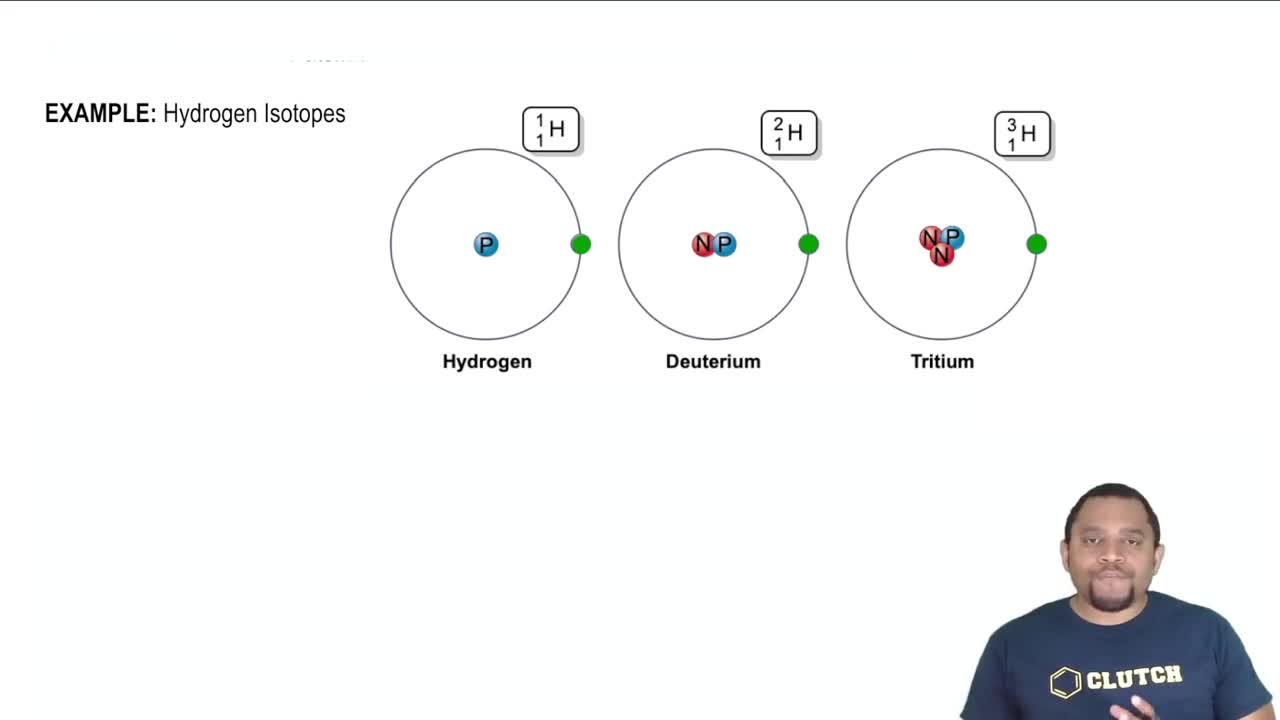
Isotopes

Isotopes are variants of a chemical element that have the same number of protons but different numbers of neutrons, resulting in different atomic masses. For chlorine, the two isotopes are Cl35 and Cl37, which have atomic masses of approximately 34.969 amu and 36.966 amu, respectively. Understanding isotopes is crucial for calculating the average atomic mass of an element based on its isotopic distribution.
Recommended video:
Guided course
03:06
Understanding the hydrogen isotopes.

Weighted Average

The atomic mass of an element is calculated as a weighted average of the masses of its isotopes, taking into account their relative abundances. In this case, the atomic mass of chlorine is determined by multiplying the mass of each isotope by its percentage abundance, summing these products, and then dividing by 100. This method reflects the contribution of each isotope to the overall atomic mass.
Recommended video:
Guided course
05:23
The (M + 2) Peak

Atomic Mass Unit (amu)

An atomic mass unit (amu) is a standard unit of mass that quantifies mass on an atomic or molecular scale. It is defined as one twelfth of the mass of a carbon-12 atom. In the context of isotopes, the atomic masses of Cl35 and Cl37 are expressed in amu, which allows for consistent calculations when determining the average atomic mass of chlorine based on its isotopic composition.
Recommended video:
Guided course
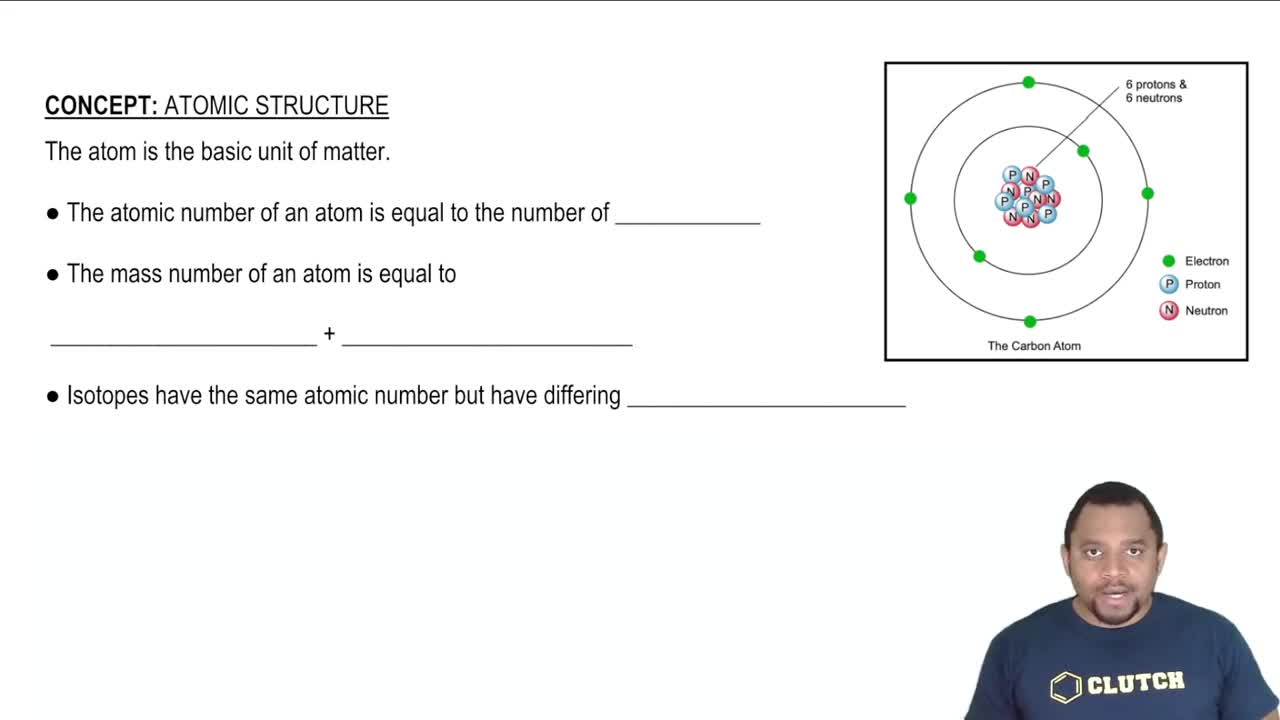
01:44
The difference between atomic numbers and atomic mass.