Textbook Question
Write the ground-state electronic configuration for chlorine (atomic number 17), bromine (atomic number 35), and iodine (atomic number 53).
1374
views

 Bruice 8th EditionCh. 1 - Remembering General Chemistry: Electronic Structure and Bonding (Part 1)Problem 5b
 Verified step by step guidance
 03:40
03:40
 06:56
06:56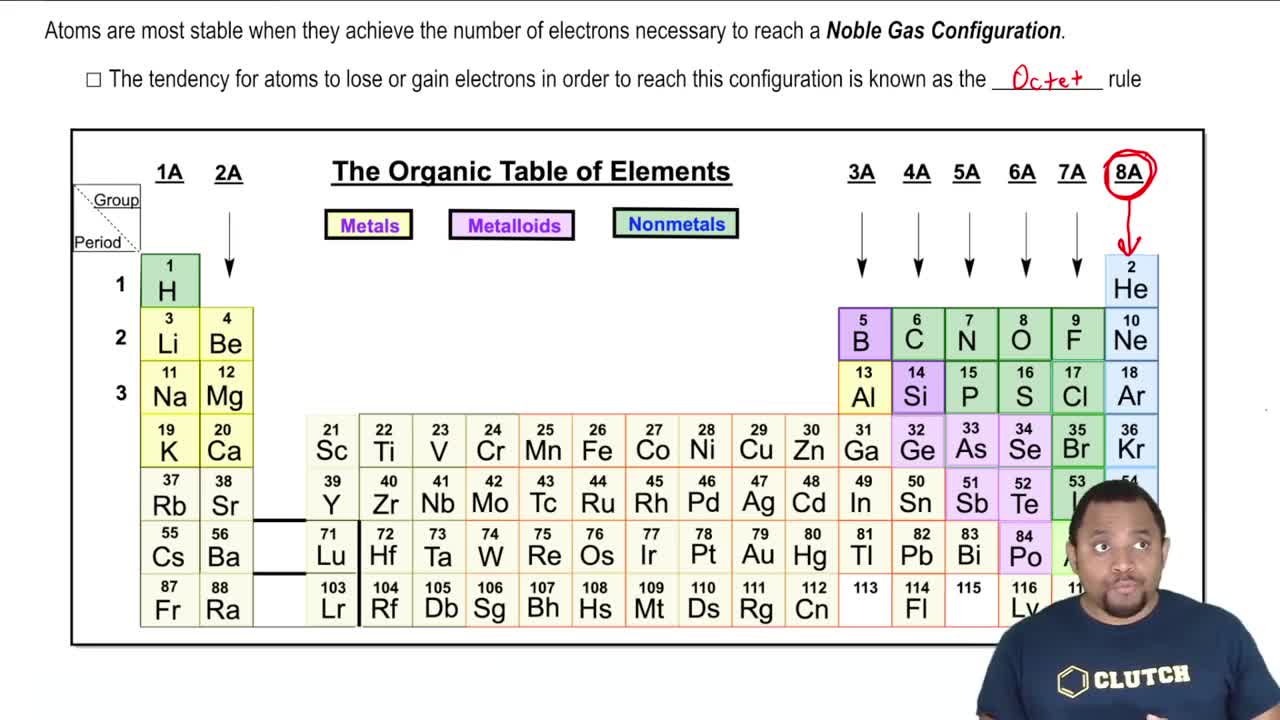 02:24
02:24Write the ground-state electronic configuration for chlorine (atomic number 17), bromine (atomic number 35), and iodine (atomic number 53).
Look at the relative positions of each pair of atoms listed here in the periodic table. How many core electrons does each have? How many valence electrons does each have?
c. nitrogen and phosphorus
d. magnesium and calcium
How many valence electrons do the following atoms have?
a. boron
b. nitrogen
Chlorine has two isotopes, 35Cl and 37Cl; 75.77% of chlorine is 35Cl, and 24.23% is 37Cl. The atomic mass of 35Cl is 34.969 amu, and the atomic mass of 37Cl is 36.966 amu. What is the atomic mass of chlorine?
Look at the relative positions of each pair of atoms listed here in the periodic table. How many core electrons does each have? How many valence electrons does each have?
a. carbon and silicon
b. oxygen and sulfur
a. Find potassium (K) in the periodic table and predict how many valence electrons it has.
b. What orbital does the unpaired electron occupy?