Ch. 11 - Organometallic Compounds
Bruice - Organic Chemistry 8th Edition
Bruice8th EditionOrganic ChemistryISBN: 9780135213711Not the one you use?Change textbook
Chapter 12, Problem 45a

Metathesis of which of the following sets of alkenes leads to the highest yield of a single alkene?
1. 1-butene and 1-pentene 
2. 2-butene and 3-hexene 
3. 2-butene and 1-pentene

Verified step by step guidance
1
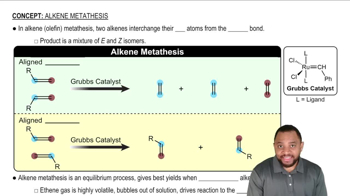
Step 1: Understand the concept of alkene metathesis. Alkene metathesis is a reaction where two alkenes exchange their alkylidene groups, forming new alkenes. The reaction is catalyzed by metal carbene complexes, and the product distribution depends on the stability and symmetry of the resulting alkenes.
Step 2: Analyze the given sets of alkenes. For each pair, consider the possible products of the metathesis reaction. The reaction involves breaking the double bonds of the alkenes and recombining the fragments to form new alkenes.
Step 3: Evaluate the stability of the potential products. The highest yield of a single alkene is achieved when the reaction favors the formation of a single, thermodynamically stable product. Symmetry and substitution patterns of the alkenes play a key role in determining the product distribution.
Step 4: For each pair of alkenes: (1) 1-butene and 1-pentene, (2) 2-butene and 3-hexene, and (3) 2-butene and 1-pentene, write the possible products of the metathesis reaction. Consider the substitution patterns of the resulting alkenes and their relative stabilities (e.g., more substituted alkenes are generally more stable).
Step 5: Compare the product distributions for each pair. Identify the pair that leads to the formation of a single, stable alkene as the major product. This pair will correspond to the highest yield of a single alkene.

Verified video answer for a similar problem:

This video solution was recommended by our tutors as helpful for the problem above.
Video duration:
8m
Was this helpful?

Key Concepts

Here are the essential concepts you must grasp in order to answer the question correctly.

Alkene Metathesis

Alkene metathesis is a chemical reaction that involves the exchange of alkyl groups between alkenes, leading to the formation of new alkenes. This reaction is facilitated by catalysts, such as those based on molybdenum or tungsten, and is significant in organic synthesis for producing higher-value compounds. Understanding the mechanism and factors influencing the reaction is crucial for predicting the outcomes of different alkene combinations.
Recommended video:
2:09
Alkene Metathesis Concept 1

Thermodynamic Stability of Alkenes

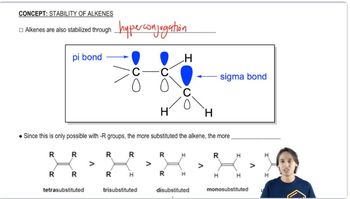
The stability of alkenes is influenced by their degree of substitution; more substituted alkenes are generally more stable due to hyperconjugation and the inductive effect. In metathesis, the formation of more stable alkenes typically leads to higher yields. Recognizing the stability of the potential products formed from the metathesis reaction helps in determining which alkene pair will yield the most favorable outcome.
Recommended video:
Guided course
04:28
Understanding trends of alkene stability.

Selectivity in Metathesis Reactions

Selectivity in metathesis reactions refers to the preference for forming certain products over others based on the starting materials. Factors such as sterics, electronic effects, and the nature of the catalyst can influence selectivity. Analyzing the structure of the alkenes involved allows chemists to predict which combinations will yield a single, predominant alkene, thus maximizing the efficiency of the reaction.
Recommended video:
2:09
Alkene Metathesis Concept 1