


Ch. 11 - Organometallic Compounds
Bruice - Organic Chemistry 8th Edition
Bruice8th EditionOrganic ChemistryISBN: 9780135213711Not the one you use?Change textbook
Chapter 12, Problem 42a

Which of the following compounds cannot be prepared by a Heck reaction?
Chemical structures labeled A, B, and C, with a question about which compound cannot be prepared by a Heck reaction.

Verified step by step guidance
1
Step 1: Understand the Heck reaction. The Heck reaction is a palladium-catalyzed coupling reaction between an aryl or vinyl halide and an alkene, resulting in the formation of a substituted alkene. The reaction typically requires a halide (such as bromide or iodide) and an alkene with a terminal double bond.
Step 2: Analyze compound A. Compound A contains two conjugated double bonds. This structure can be formed via a Heck reaction because it involves the coupling of a halide with a terminal alkene, leading to conjugation.
Step 3: Analyze compound B. Compound B contains a double bond in the middle of the chain, not at the terminal position. The Heck reaction generally requires a terminal alkene for the coupling process, so this compound cannot be prepared by a Heck reaction.
Step 4: Analyze compound C. Compound C contains a double bond adjacent to a carbonyl group. This structure can be formed via a Heck reaction because the carbonyl group can stabilize the intermediate formed during the reaction, making it feasible.
Step 5: Conclude that compound B cannot be prepared by a Heck reaction due to the lack of a terminal double bond, which is a key requirement for this reaction.

Verified video answer for a similar problem:

This video solution was recommended by our tutors as helpful for the problem above.
Video duration:
2m
Was this helpful?

Key Concepts

Here are the essential concepts you must grasp in order to answer the question correctly.

Heck Reaction

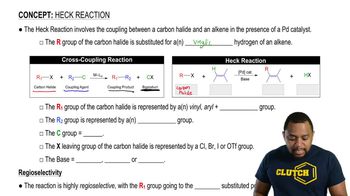
The Heck reaction is a palladium-catalyzed coupling reaction between an aryl or vinyl halide and an alkene, resulting in the formation of substituted alkenes. This reaction is significant in organic synthesis for constructing complex molecules and is particularly useful for forming carbon-carbon bonds. Understanding the mechanism and the types of substrates that can participate is crucial for predicting the products formed.
Recommended video:
Guided course
05:09
Heck Reaction

Substrate Compatibility

In the context of the Heck reaction, substrate compatibility refers to the ability of specific reactants to undergo the reaction successfully. Factors such as sterics, electronics, and the presence of functional groups influence whether a compound can be synthesized via this method. Recognizing which substrates are suitable helps in determining the feasibility of preparing a desired compound.
Recommended video:
1:55
Nicotinamide Adenine Dinucleotide Example 2

Functional Group Tolerance

Functional group tolerance in organic reactions indicates how well different functional groups can coexist in a reaction without interfering with the desired transformation. In the Heck reaction, certain functional groups may be incompatible, leading to side reactions or failure to produce the desired product. Understanding this concept is essential for predicting which compounds can be synthesized and which cannot.
Recommended video:
Guided course
02:36
Identifying Functional Groups