Ch. 11 - Organometallic Compounds
Bruice - Organic Chemistry 8th Edition
Bruice8th EditionOrganic ChemistryISBN: 9780135213711Not the one you use?Change textbook
Chapter 12, Problem 41b

Using the given starting material, any necessary inorganic reagents, and any carbon-containing compounds with no more than two carbons, indicate how each of the following compounds can be prepared:
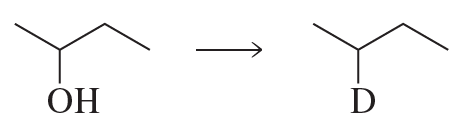
b. Chemical reaction showing the conversion of an alcohol (OH) to a compound with a deuterium (D) atom.

Verified step by step guidance
1
Step 1: Analyze the starting material and the target compound. The starting material is 2-butanol, and the target compound is 2-deuterobutane, where the hydroxyl group (-OH) is replaced with a deuterium atom (D). This indicates a substitution reaction.
Step 2: Convert the hydroxyl group (-OH) of 2-butanol into a good leaving group. This can be achieved by reacting 2-butanol with a reagent like thionyl chloride (SOCl₂) or phosphorus tribromide (PBr₃) to form 2-bromobutane or 2-chlorobutane.
Step 3: Perform a nucleophilic substitution reaction to replace the halogen (Br or Cl) with a deuterium atom (D). Use deuterium oxide (D₂O) in the presence of a strong base like sodium deuteroxide (NaOD) to facilitate the exchange.
Step 4: Ensure the reaction conditions are mild to avoid elimination reactions, which could lead to the formation of alkenes instead of the desired substitution product.
Step 5: Purify the product using techniques like distillation or chromatography to isolate 2-deuterobutane and confirm its structure using spectroscopic methods such as NMR or IR.

Verified video answer for a similar problem:

This video solution was recommended by our tutors as helpful for the problem above.
Video duration:
4m
Was this helpful?

Key Concepts

Here are the essential concepts you must grasp in order to answer the question correctly.

Alcohol Functional Group

Alcohols are organic compounds characterized by the presence of one or more hydroxyl (-OH) groups attached to a carbon atom. The reactivity of alcohols can vary based on their structure, such as primary, secondary, or tertiary alcohols, which influences their ability to undergo various chemical reactions, including oxidation and substitution.
Recommended video:
Guided course
02:36
Identifying Functional Groups

Reagents for Conversion

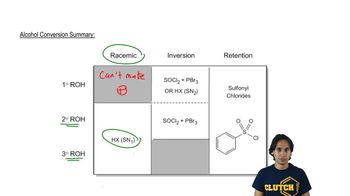
In organic synthesis, specific reagents are used to facilitate the conversion of one functional group to another. For example, alcohols can be converted to alkenes through dehydration reactions, or to alkyl halides via substitution reactions. Understanding the appropriate reagents and conditions is crucial for successful transformations.
Recommended video:
Guided course
04:30
Comparing and contrasting the Alcohol Conversions.

Mechanism of Reaction

The mechanism of a reaction describes the step-by-step process by which reactants are converted into products. This includes the breaking and forming of bonds, the movement of electrons, and the intermediates formed during the reaction. A clear understanding of the mechanism helps predict the outcome of the reaction and the stability of intermediates.
Recommended video:
Guided course
02:16
Heck Reaction Mechanism