Ch. 13 - Mass Spectrometry; Infrared Spectroscopy; UV/Vis Spectroscopy
Bruice - Organic Chemistry 8th Edition
Bruice8th EditionOrganic ChemistryISBN: 9780135213711Not the one you use?Change textbook
Chapter 14, Problem 67a,b

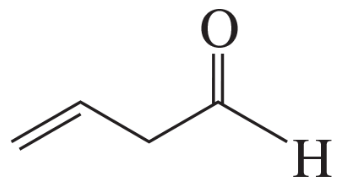
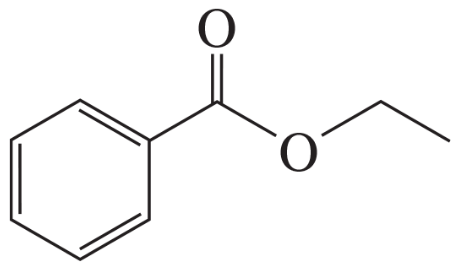
Give approximate wavenumbers for the major characteristic IR absorption bands that would be given by each of the following compounds:
a.
b.

Verified step by step guidance
1
Step 1: Analyze the structure of compound I. It contains a benzene ring and a ketone functional group. The benzene ring will exhibit characteristic IR absorption bands due to C-H stretching (around 3000-3100 cm⁻¹) and C=C stretching (around 1500-1600 cm⁻¹). The ketone group will show a strong C=O stretching band near 1700 cm⁻¹.
Step 2: Analyze the structure of compound II. It contains an alkene group, an ester functional group, and an ether group. The alkene will exhibit C-H stretching (around 3000-3100 cm⁻¹) and C=C stretching (around 1600-1680 cm⁻¹). The ester group will show a strong C=O stretching band near 1735-1750 cm⁻¹ and C-O stretching bands near 1000-1300 cm⁻¹.
Step 3: For compound I, note that the benzene ring may also exhibit overtone bands in the region of 1800-2000 cm⁻¹, which are weaker but characteristic of aromatic compounds.
Step 4: For compound II, the ether group will exhibit C-O stretching bands near 1000-1300 cm⁻¹, which overlap with the ester C-O stretching bands. This region is typically broad and complex due to multiple overlapping vibrations.
Step 5: Summarize the major IR absorption bands for each compound based on their functional groups and structural features. Compound I will primarily show bands for aromatic and ketone groups, while compound II will show bands for alkene, ester, and ether groups.

Verified video answer for a similar problem:

This video solution was recommended by our tutors as helpful for the problem above.
Video duration:
5m
Was this helpful?

Key Concepts

Here are the essential concepts you must grasp in order to answer the question correctly.

Infrared (IR) Spectroscopy

Infrared spectroscopy is a technique used to identify functional groups in organic compounds by measuring the absorption of infrared light at specific wavelengths. Each functional group has characteristic absorption bands, which correspond to the vibrations of chemical bonds. Understanding these bands allows chemists to deduce the presence of specific functional groups in a molecule.
Recommended video:
Guided course
16:04
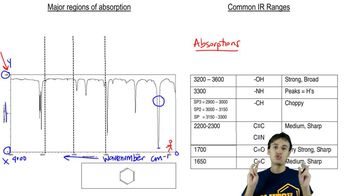
General Features of IR Spect

Wavenumber

Wavenumber is a unit of measurement used in spectroscopy, defined as the number of wave cycles per unit distance, typically expressed in cm⁻¹. It is inversely related to wavelength and directly proportional to energy; higher wavenumbers correspond to higher energy transitions. In IR spectroscopy, wavenumbers are used to specify the frequencies at which molecular vibrations occur, aiding in the identification of functional groups.

Characteristic Absorption Bands

Characteristic absorption bands are specific ranges of wavenumbers where certain functional groups absorb infrared radiation. For example, carbonyl groups (C=O) typically absorb around 1700 cm⁻¹, while hydroxyl groups (O-H) absorb around 3200-3600 cm⁻¹. Recognizing these bands is crucial for interpreting IR spectra and determining the structure of organic compounds.
Recommended video:
Guided course
02:02
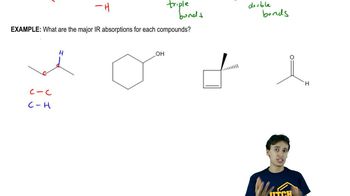
Major IR absorptions