


Ch. 13 - Mass Spectrometry; Infrared Spectroscopy; UV/Vis Spectroscopy
Bruice - Organic Chemistry 8th Edition
Bruice8th EditionOrganic ChemistryISBN: 9780135213711Not the one you use?Change textbook
Chapter 14, Problem 61a

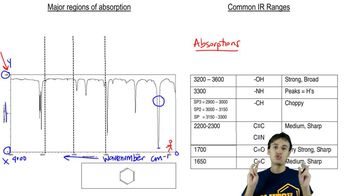
Each of the IR spectra shown below is accompanied by a set of four compounds. In each case, indicate which of the four compounds is responsible for the spectrum.
a.
<IMAGE>

Verified step by step guidance
1
Step 1: Begin by analyzing the IR spectrum provided. Identify the key absorption peaks and their corresponding wavenumbers (in cm⁻¹). Look for characteristic functional group signals such as O-H, N-H, C=O, C-H, C≡C, or C≡N stretches.
Step 2: Compare the observed absorption peaks with the known IR absorption ranges for functional groups. For example, a broad peak around 3200-3600 cm⁻¹ suggests an O-H stretch (alcohol or carboxylic acid), while a sharp peak near 1700 cm⁻¹ indicates a C=O stretch (carbonyl group).
Step 3: Examine the molecular structures of the four compounds provided. Identify the functional groups present in each compound and predict the IR absorption peaks they would produce.
Step 4: Match the observed IR spectrum with the predicted peaks for each compound. Focus on unique or distinguishing peaks that can help differentiate between the compounds.
Step 5: Based on the comparison, determine which compound's functional groups and predicted IR absorptions align best with the observed spectrum. This compound is responsible for the given IR spectrum.

Verified video answer for a similar problem:

This video solution was recommended by our tutors as helpful for the problem above.
Video duration:
2m
Was this helpful?

Key Concepts

Here are the essential concepts you must grasp in order to answer the question correctly.

Infrared Spectroscopy (IR)

Infrared spectroscopy is an analytical technique used to identify molecular structures by measuring the absorption of infrared light by a sample. Different functional groups in a molecule absorb characteristic wavelengths of IR radiation, resulting in a spectrum that can be analyzed to determine the presence of specific bonds and functional groups.
Recommended video:
Guided course
16:04
General Features of IR Spect

Functional Groups

Functional groups are specific groups of atoms within molecules that are responsible for the characteristic chemical reactions of those molecules. Common functional groups include hydroxyl (-OH), carbonyl (C=O), and carboxyl (-COOH). Identifying these groups in a compound is crucial for interpreting IR spectra, as each group has a unique absorption pattern.
Recommended video:
Guided course
02:36
Identifying Functional Groups

Spectrum Interpretation

Interpreting an IR spectrum involves analyzing the peaks and troughs that correspond to different vibrational modes of molecular bonds. The position and intensity of these peaks provide information about the types of bonds present in the compound. By comparing the observed spectrum with known reference spectra, one can deduce which compound corresponds to the given spectrum.
Recommended video:
Guided course
06:06
How to interpret condensed structures.
Related Practice
Textbook Question

The IR spectrum of compound A with a molecular formula of C5H12O is shown below. Compound A is oxidized to give compound B, a ketone with a molecular formula of C5H10O. When compound A is heated with H2SO4, compounds C and D are obtained. Considerably more D is obtained than C. Reaction of compound C with O3, followed by treatment with dimethyl sulfide, gives two products: formaldehyde and compound E, with a molecular formula of C4H8O. Reaction of compound D with O3, followed by treatment with dimethyl sulfide, gives two products: compound F, with a molecular formula of C3H6O, and compound G, with a molecular formula of C2H4O. What are the structures of compounds A through G?

<IMAGE>

1131
views
Textbook Question

Which one of the following five compounds produced the IR spectrum shown below?

<IMAGE>

1352
views
Textbook Question

Five compounds are shown for each of the IR spectra below. Indicate which of the five compounds is responsible for each spectrum.

c.

<IMAGE>

1740
views
Textbook Question

How can IR spectroscopy distinguish between 1-hexyne, 2-hexyne, and 3-hexyne?

1851
views
Textbook Question

Give approximate wavenumbers for the major characteristic IR absorption bands that would be given by each of the following compounds:

a.

b.

1065
views
Textbook Question

The mass spectrum for a compound with molecular weight of 102 is shown below. Its IR spectrum has a broad, strong absorption at 3600 cm–1 and a medium absorption at 1360 cm–1.

b. Show the mechanism for formation of the peak at m/z = 84.

<IMAGE>

1566
views