
Ch. 13 - Mass Spectrometry; Infrared Spectroscopy; UV/Vis Spectroscopy
Bruice - Organic Chemistry 8th Edition
Bruice8th EditionOrganic ChemistryISBN: 9780135213711Not the one you use?Change textbook
Chapter 14, Problem 64

How can IR spectroscopy distinguish between 1-hexyne, 2-hexyne, and 3-hexyne?

Verified step by step guidance
1
Identify the functional group of interest in the molecules: All three compounds (1-hexyne, 2-hexyne, and 3-hexyne) are alkynes, which contain a carbon-carbon triple bond (C≡C). IR spectroscopy can be used to detect the presence and location of this bond.
Understand the key IR absorption regions for alkynes: The C≡C triple bond typically absorbs in the range of 2100–2260 cm⁻¹. Additionally, terminal alkynes (like 1-hexyne) have a characteristic ≡C-H stretch around 3300 cm⁻¹, which is absent in internal alkynes (like 2-hexyne and 3-hexyne).
Analyze 1-hexyne: Since 1-hexyne is a terminal alkyne, it will show both the C≡C stretch in the 2100–2260 cm⁻¹ region and the ≡C-H stretch around 3300 cm⁻¹. This distinguishes it from the other two compounds.
Analyze 2-hexyne and 3-hexyne: Both are internal alkynes, so they will show the C≡C stretch in the 2100–2260 cm⁻¹ region but will lack the ≡C-H stretch around 3300 cm⁻¹. To differentiate between these two, additional structural analysis (e.g., NMR spectroscopy) may be required, as IR alone cannot distinguish between different internal alkyne positions.
Summarize the distinguishing features: IR spectroscopy can differentiate 1-hexyne from 2-hexyne and 3-hexyne based on the presence of the ≡C-H stretch at 3300 cm⁻¹. However, it cannot distinguish between 2-hexyne and 3-hexyne, as both are internal alkynes with similar IR spectra in the relevant regions.

Verified video answer for a similar problem:

This video solution was recommended by our tutors as helpful for the problem above.
Video duration:
3m
Was this helpful?

Key Concepts

Here are the essential concepts you must grasp in order to answer the question correctly.

Infrared (IR) Spectroscopy

IR spectroscopy is an analytical technique used to identify functional groups in organic compounds by measuring the absorption of infrared light. Different bonds absorb characteristic frequencies of IR radiation, leading to distinct peaks in the spectrum. This allows chemists to determine the presence of specific functional groups and structural features in molecules.
Recommended video:
Guided course
16:04
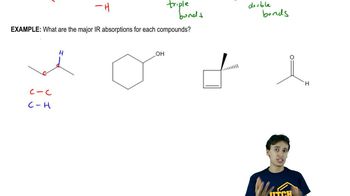
General Features of IR Spect

Alkyne Structure and Isomerism

Alkynes are hydrocarbons containing at least one carbon-carbon triple bond. The position of this triple bond can vary, leading to structural isomers such as 1-hexyne, 2-hexyne, and 3-hexyne. Each isomer has a unique arrangement of atoms, which affects its IR absorption characteristics, making it possible to distinguish between them using IR spectroscopy.
Recommended video:
Guided course
09:11
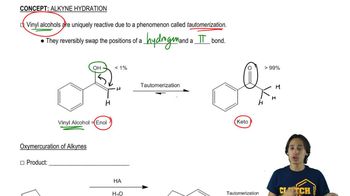
Alkyne Hydration

Characteristic IR Absorption Peaks

Each type of bond in a molecule has a specific range of IR absorption frequencies. For alkynes, the C≡C triple bond typically shows a strong absorption around 2100-2260 cm⁻¹. Additionally, the position of the triple bond in 1-hexyne, 2-hexyne, and 3-hexyne results in different peak patterns and intensities, allowing for their differentiation in an IR spectrum.
Recommended video:
Guided course
02:02
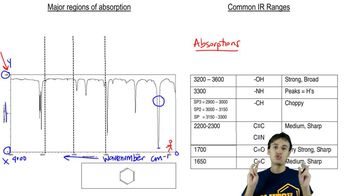
Major IR absorptions
Related Practice
Textbook Question

The IR spectrum of compound A with a molecular formula of C5H12O is shown below. Compound A is oxidized to give compound B, a ketone with a molecular formula of C5H10O. When compound A is heated with H2SO4, compounds C and D are obtained. Considerably more D is obtained than C. Reaction of compound C with O3, followed by treatment with dimethyl sulfide, gives two products: formaldehyde and compound E, with a molecular formula of C4H8O. Reaction of compound D with O3, followed by treatment with dimethyl sulfide, gives two products: compound F, with a molecular formula of C3H6O, and compound G, with a molecular formula of C2H4O. What are the structures of compounds A through G?

<IMAGE>

1131
views
Textbook Question

Give approximate wavenumbers for the major characteristic IR absorption bands that would be given by each of the following compounds:

e.

f.

845
views
Textbook Question

Five compounds are shown for each of the IR spectra below. Indicate which of the five compounds is responsible for each spectrum.

c.

<IMAGE>

1740
views
Textbook Question

Give approximate wavenumbers for the major characteristic IR absorption bands that would be given by each of the following compounds:

a.

b.

1065
views
Textbook Question

Each of the IR spectra shown below is accompanied by a set of four compounds. In each case, indicate which of the four compounds is responsible for the spectrum.

a.

<IMAGE>

1260
views
Textbook Question

Phenolphthalein is an acid–base indicator. In solutions of pH < 8.5, it is colorless; in solutions of pH > 8.5, it is deep red-purple. Account for the change in color.

1356
views