Ch. 16 - Reactions of Aldehydes and Ketones • More Reactions of Carboxylic Acid Derivatives
Bruice - Organic Chemistry 8th Edition
Bruice8th EditionOrganic ChemistryISBN: 9780135213711Not the one you use?Change textbook
Chapter 17, Problem 57a(7)

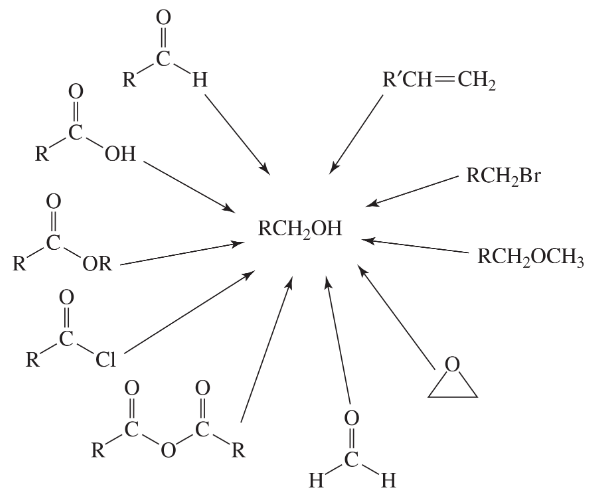
a. Show the reagents required to form the primary alcohol in each of the following reactions.


Verified step by step guidance
1
Step 1: Identify the starting material and the product. The starting material is an epoxide (a three-membered cyclic ether), and the product is a primary alcohol.
Step 2: Recognize the type of reaction. This is a ring-opening reaction of the epoxide to form a primary alcohol. The nucleophile attacks the less substituted carbon of the epoxide due to steric hindrance.
Step 3: Choose the appropriate nucleophile and acidic or basic conditions. To form a primary alcohol, water (H₂O) can act as the nucleophile, and an acid catalyst such as H⁺ (e.g., H₂SO₄) is typically used to protonate the epoxide and facilitate the ring opening.
Step 4: Describe the mechanism. The epoxide is protonated by the acid catalyst, making the oxygen more electrophilic. Water then attacks the less substituted carbon of the epoxide, leading to the formation of the primary alcohol.
Step 5: Summarize the reagents required. The reaction requires water (H₂O) as the nucleophile and an acid catalyst (e.g., H₂SO₄) to form the primary alcohol from the epoxide.

Verified video answer for a similar problem:

This video solution was recommended by our tutors as helpful for the problem above.
Video duration:
5m
Was this helpful?

Key Concepts

Here are the essential concepts you must grasp in order to answer the question correctly.

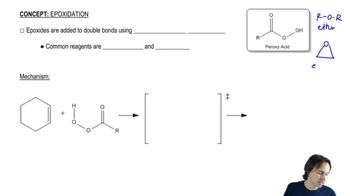
Epoxide Chemistry

Epoxides are three-membered cyclic ethers that are highly reactive due to the strain in their ring structure. They can undergo ring-opening reactions in the presence of nucleophiles, leading to the formation of various products, including alcohols. Understanding the mechanism of epoxide ring-opening is crucial for predicting the outcome of reactions involving these compounds.
Recommended video:
Guided course
02:19
General properties of epoxidation.

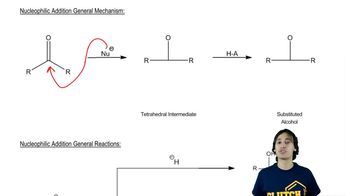
Nucleophilic Attack

Nucleophilic attack is a fundamental concept in organic chemistry where a nucleophile, which is an electron-rich species, attacks an electron-deficient center, such as a carbon atom in an epoxide. This process often leads to the formation of new bonds and is essential for converting epoxides into alcohols. The regioselectivity of the attack can influence the final product's structure.
Recommended video:
Guided course
08:27
Nucleophilic Addition

Reagents for Alcohol Formation

To convert an epoxide into a primary alcohol, specific reagents are required. Typically, a nucleophile such as water or an alcohol is used in the presence of an acid catalyst to facilitate the ring-opening. The choice of nucleophile and conditions can determine whether the resulting alcohol is primary, secondary, or tertiary, making it important to select the appropriate reagents for the desired outcome.
Recommended video: