Ch. 16 - Reactions of Aldehydes and Ketones • More Reactions of Carboxylic Acid Derivatives
Bruice - Organic Chemistry 8th Edition
Bruice8th EditionOrganic ChemistryISBN: 9780135213711Not the one you use?Change textbook
Chapter 17, Problem 57b

Which of the reactions cannot be used for the synthesis of isobutyl alcohol?

Verified step by step guidance
1
Step 1: Analyze the chemical structure of isobutyl alcohol (C4H10O). It is a primary alcohol with the formula (CH3)2CHCH2OH. The synthesis of isobutyl alcohol requires reactions that yield this specific structure.
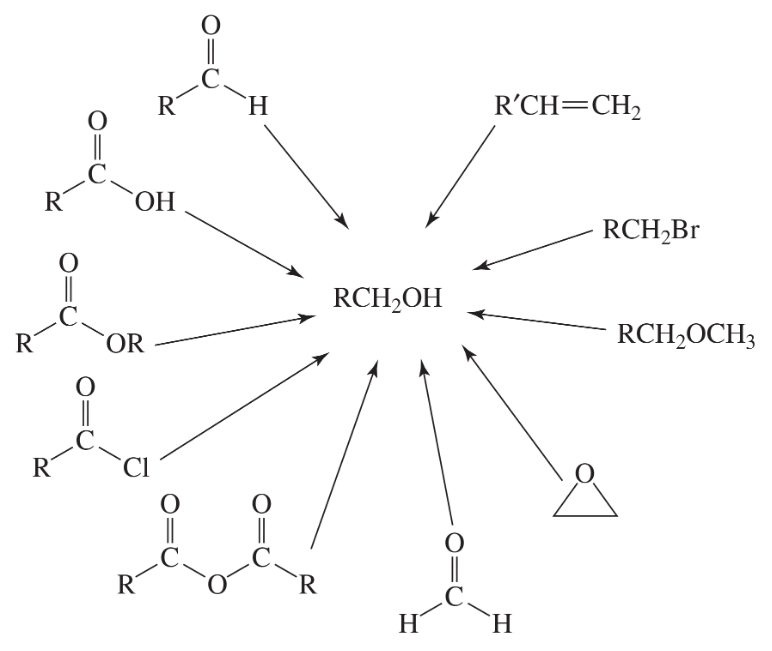
Step 2: Examine the provided reaction pathways in the image. Each pathway involves different starting materials and reagents that could potentially lead to the formation of RCH2OH (a general alcohol structure). Determine which reactions are compatible with the formation of isobutyl alcohol.
Step 3: Consider the reaction involving R'CH=CH2 (alkene). This reaction typically undergoes hydroboration-oxidation or acid-catalyzed hydration to form alcohols. However, the product may not necessarily be isobutyl alcohol unless the alkene is specifically structured to yield the desired alcohol.
Step 4: Evaluate the reaction involving RCH2Br (alkyl bromide). This reaction can proceed via nucleophilic substitution (e.g., SN2) with hydroxide ions to form alcohols. The structure of the alkyl bromide must match the isobutyl alcohol precursor for this pathway to be valid.
Step 5: Assess the reaction involving epoxides (three-membered cyclic ethers). Epoxides react with nucleophiles like water or hydroxide ions to form alcohols. The regioselectivity of the reaction depends on the structure of the epoxide, and it may not yield isobutyl alcohol unless the epoxide is specifically designed for this purpose.

Verified video answer for a similar problem:

This video solution was recommended by our tutors as helpful for the problem above.
Video duration:
2m
Was this helpful?

Key Concepts

Here are the essential concepts you must grasp in order to answer the question correctly.

Alcohol Synthesis

Alcohol synthesis involves various chemical reactions that convert starting materials into alcohols. Understanding the mechanisms and reagents used in these reactions is crucial for determining which pathways can yield specific alcohols, such as isobutyl alcohol. Common methods include reduction of carbonyl compounds and substitution reactions.
Recommended video:
Guided course
02:26
Forming alcohols through Oxymercuration-Reduction.

Isobutyl Alcohol Structure

Isobutyl alcohol, or 2-methyl-1-propanol, has a specific molecular structure that influences its synthesis. Recognizing its structure helps in identifying the appropriate precursors and reaction conditions needed to produce it. The branched nature of isobutyl alcohol can limit the types of reactions that can be used for its synthesis.
Recommended video:
Guided course
01:01
How to name alcohols

Reaction Mechanisms

Understanding reaction mechanisms is essential for predicting the outcomes of chemical reactions. Different mechanisms, such as nucleophilic substitution or elimination, can lead to different products. Analyzing the mechanisms involved in the proposed reactions will help determine which ones are viable for synthesizing isobutyl alcohol.
Recommended video:
Guided course
02:16
Heck Reaction Mechanism