Ch. 16 - Reactions of Aldehydes and Ketones • More Reactions of Carboxylic Acid Derivatives
Bruice - Organic Chemistry 8th Edition
Bruice8th EditionOrganic ChemistryISBN: 9780135213711Not the one you use?Change textbook
Chapter 17, Problem 58d

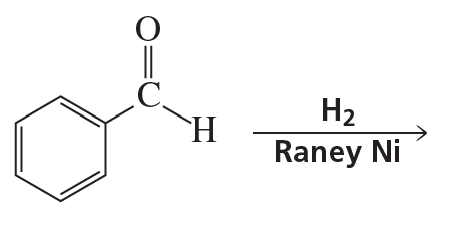
Draw the products of the following reactions. Indicate whether each reaction is an oxidation or a reduction.
d. Chemical reaction diagram showing a carbonyl compound reacting with hydrogen in the presence of Raney nickel catalyst.

Verified step by step guidance
1
Step 1: Identify the functional group in the reactant. The given compound contains an aldehyde group (-CHO) attached to a cyclohexane ring.
Step 2: Recognize the reagents used in the reaction. The reaction involves hydrogen gas (H₂) and Raney nickel, which is a catalyst commonly used for hydrogenation reactions.
Step 3: Understand the reaction mechanism. Hydrogenation typically reduces the aldehyde group to a primary alcohol by adding hydrogen atoms to the carbonyl group.
Step 4: Determine the type of reaction. Since the aldehyde is being reduced to an alcohol, this reaction is classified as a reduction reaction.
Step 5: Draw the product. Replace the aldehyde group (-CHO) with a primary alcohol group (-CH₂OH) while keeping the cyclohexane ring intact.

Verified video answer for a similar problem:

This video solution was recommended by our tutors as helpful for the problem above.
Video duration:
2m
Was this helpful?

Key Concepts

Here are the essential concepts you must grasp in order to answer the question correctly.

Reduction Reaction

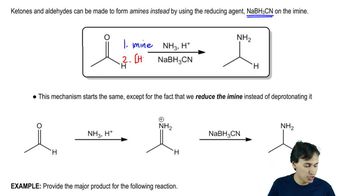
A reduction reaction involves the gain of electrons or hydrogen by a molecule, resulting in a decrease in oxidation state. In organic chemistry, this often refers to the conversion of carbonyl groups (C=O) to alcohols (C-OH) through the addition of hydrogen. The reaction shown in the question is a classic example of reduction, where a carbonyl compound is transformed into an alcohol.
Recommended video:
Guided course
07:12
Reductive Amination

Catalysts in Organic Reactions

Catalysts are substances that increase the rate of a chemical reaction without being consumed in the process. In the context of the given reaction, Raney nickel (Raney Ni) serves as a catalyst for hydrogenation, facilitating the addition of hydrogen to the carbonyl compound. Understanding the role of catalysts is crucial for predicting reaction pathways and product formation in organic chemistry.
Recommended video:
1:22
Introduction to Catalysis Example 1

Oxidation-Reduction (Redox) Reactions

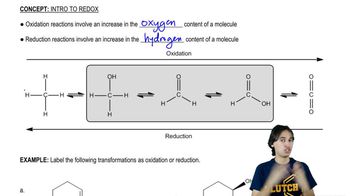
Oxidation-reduction (redox) reactions involve the transfer of electrons between two species, where one is oxidized (loses electrons) and the other is reduced (gains electrons). Identifying whether a reaction is an oxidation or reduction is essential for understanding the changes in oxidation states of the reactants. In the provided reaction, the carbonyl compound is reduced, indicating a gain of hydrogen and a decrease in oxidation state.
Recommended video:
Guided course
06:02
General Features of Redox