Ch. 16 - Reactions of Aldehydes and Ketones • More Reactions of Carboxylic Acid Derivatives
Bruice - Organic Chemistry 8th Edition
Bruice8th EditionOrganic ChemistryISBN: 9780135213711Not the one you use?Change textbook
Chapter 17, Problem 58e

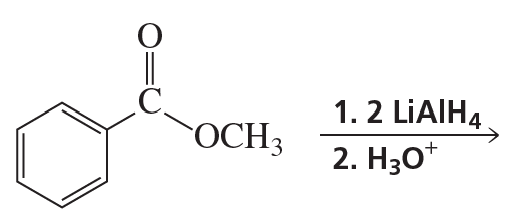
Draw the products of the following reactions. Indicate whether each reaction is an oxidation or a reduction.
e. Chemical structure of a carbonyl compound with reaction conditions for reduction using lithium aluminum hydride.

Verified step by step guidance
1
Step 1: Analyze the given reaction. The starting material is a methyl ester (cyclohexanecarboxylic acid methyl ester), and the reagents are lithium aluminum hydride (LiAlH4) followed by acid workup (H3O+). LiAlH4 is a strong reducing agent used to reduce esters to primary alcohols.
Step 2: Understand the mechanism. LiAlH4 donates hydride ions (H-) to the carbonyl carbon of the ester, breaking the C=O bond and forming an intermediate alkoxide. The methoxy group (-OCH3) is displaced as methanol during the reaction.
Step 3: After the reduction by LiAlH4, the intermediate alkoxide is protonated during the acid workup (H3O+), resulting in the formation of a primary alcohol. The ester group is completely reduced to an alcohol.
Step 4: Identify the product. The ester group (-COOCH3) in cyclohexanecarboxylic acid methyl ester is reduced to a primary alcohol (-CH2OH), resulting in cyclohexanemethanol as the product.
Step 5: Classify the reaction. Since the reaction involves the addition of hydrogen (reduction of the ester to an alcohol), it is classified as a reduction reaction.

Verified video answer for a similar problem:

This video solution was recommended by our tutors as helpful for the problem above.
Video duration:
5m
Was this helpful?

Key Concepts

Here are the essential concepts you must grasp in order to answer the question correctly.

Reduction Reactions

Reduction reactions involve the gain of electrons or hydrogen, or the loss of oxygen by a molecule. In organic chemistry, this often pertains to the conversion of carbonyl compounds (like aldehydes and ketones) into alcohols. The reaction shown in the image illustrates the reduction of a carbonyl compound using lithium aluminum hydride (LiAlH4), a strong reducing agent.
Recommended video:
Guided course
07:12
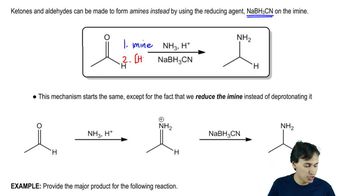
Reductive Amination

Lithium Aluminum Hydride (LiAlH4)

Lithium aluminum hydride is a powerful reducing agent commonly used in organic synthesis. It can reduce a variety of functional groups, including carbonyls and esters, to their corresponding alcohols. In the reaction depicted, LiAlH4 donates hydride ions (H-) to the carbonyl carbon, facilitating the reduction process.
Recommended video:
Guided course
02:07
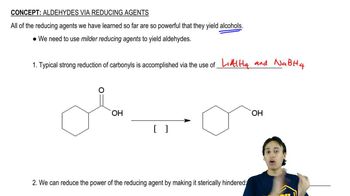
Why LiAlH4 doesn't work

Protonation of Alkoxides

After the reduction step, the alkoxide intermediate formed needs to be protonated to yield the final alcohol product. This is typically achieved by adding a proton source, such as water or an acid, as shown in the second step of the reaction. This step is crucial as it converts the alkoxide into a stable alcohol, completing the reduction process.
Recommended video:
Guided course
03:
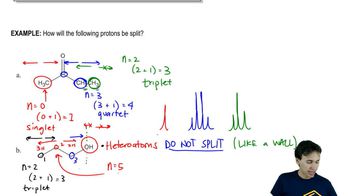
Proton Splitting