
Ch. 17 - Reactions at the Alpha-Carbon
Bruice - Organic Chemistry 8th Edition
Bruice8th EditionOrganic ChemistryISBN: 9780135213711Not the one you use?Change textbook
Chapter 18, Problem 79

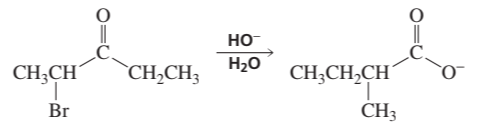
A carboxylic acid is formed when an a-haloketone reacts with hydroxide ion. This reaction is called a Favorskii reaction. Propose a mechanism for the following Favorskii reaction. (Hint: In the first step, HO- removes a proton from the a-carbon that is not bonded to Br; a three-membered ring is formed in the second step; and HO- is a nucleophile in the third step.)
Favorskii reaction mechanism showing a-haloketone converting to a carboxylic acid with hydroxide ion.

Verified step by step guidance
1
Step 1: The hydroxide ion (HO⁻) acts as a base and removes a proton from the α-carbon that is not bonded to the bromine atom. This deprotonation generates a carbanion intermediate at the α-carbon.
Step 2: The carbanion intermediate undergoes intramolecular nucleophilic attack on the carbonyl carbon, forming a three-membered cyclic intermediate known as a cyclopropanone.
Step 3: The bromine atom is expelled from the cyclopropanone intermediate, resulting in the formation of a new carbanion at the α-carbon adjacent to the carbonyl group.
Step 4: The hydroxide ion (HO⁻) acts as a nucleophile and attacks the carbonyl carbon of the intermediate, leading to the opening of the three-membered ring and formation of a tetrahedral intermediate.
Step 5: The tetrahedral intermediate undergoes proton transfer, resulting in the formation of the carboxylic acid product with the hydroxide ion regenerating as the leaving group.

Verified video answer for a similar problem:

This video solution was recommended by our tutors as helpful for the problem above.
Video duration:
6m
Was this helpful?

Key Concepts

Here are the essential concepts you must grasp in order to answer the question correctly.

Favorskii Reaction

The Favorskii reaction is a rearrangement reaction involving α-haloketones that leads to the formation of carboxylic acids. In this reaction, a hydroxide ion (HO-) acts as a base and nucleophile, facilitating the conversion of the α-haloketone into a carboxylic acid through a series of steps, including deprotonation and ring formation.
Recommended video:
Guided course
05:09
Heck Reaction

Nucleophilic Attack

Nucleophilic attack is a fundamental concept in organic chemistry where a nucleophile, which is an electron-rich species, attacks an electron-deficient center, typically a carbon atom in a carbonyl group. In the Favorskii reaction, the hydroxide ion acts as a nucleophile, attacking the electrophilic carbon in the three-membered ring formed during the reaction, leading to the final product.
Recommended video:
Guided course
08:27
Nucleophilic Addition

Three-Membered Ring Formation

The formation of a three-membered ring, often referred to as an epoxide or cyclic intermediate, is a key step in many organic reactions, including the Favorskii reaction. This intermediate is formed when a nucleophile attacks an electrophilic carbon, resulting in a cyclic structure that can stabilize the transition state and facilitate further reactions, ultimately leading to the desired product.
Recommended video:
Guided course
05:14
Ring Expansion