Ch. 17 - Reactions at the Alpha-Carbon
Bruice - Organic Chemistry 8th Edition
Bruice8th EditionOrganic ChemistryISBN: 9780135213711Not the one you use?Change textbook
Chapter 18, Problem 78

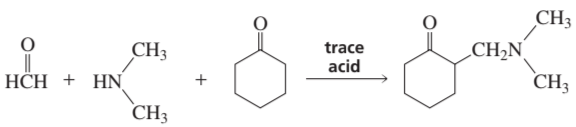
A Mannich reaction puts a Diagram illustrating a Mannich reaction with R2NCH2 group attached to a ketone's alpha-carbon.-group on the α-carbon of a ketone. Propose a mechanism for the reaction.
Verified step by step guidance
1
The Mannich reaction begins with the formation of an iminium ion. This occurs when a secondary amine (R2NH) reacts with formaldehyde (HCHO) in an acid-catalyzed environment. The formaldehyde is protonated by the acid, making it more electrophilic, and the amine attacks the carbonyl carbon to form a carbinolamine intermediate. This intermediate loses water to form the iminium ion (R2N=CH2).
Next, the ketone (or aldehyde) undergoes enolate formation. In the presence of a base, the α-hydrogen of the ketone is deprotonated, forming the enolate ion. The enolate is a nucleophile due to the negative charge on the oxygen and the resonance-stabilized negative charge on the α-carbon.
The enolate ion then attacks the electrophilic iminium ion. The nucleophilic α-carbon of the enolate adds to the carbon of the iminium ion, forming a new C-C bond. This step is the key carbon-carbon bond-forming step in the Mannich reaction.
The resulting intermediate is protonated to form the final Mannich product. This product contains the R2NCH2 group attached to the α-carbon of the ketone or aldehyde.
Finally, the reaction is neutralized, and the product is isolated. The Mannich product is a β-amino carbonyl compound, which is a versatile intermediate in organic synthesis.

Verified video answer for a similar problem:

This video solution was recommended by our tutors as helpful for the problem above.
Was this helpful?

Key Concepts

Here are the essential concepts you must grasp in order to answer the question correctly.

Mannich Reaction

The Mannich reaction is a three-component reaction that involves the condensation of an amine, formaldehyde, and a ketone or aldehyde to form a β-amino carbonyl compound. This reaction is significant in organic synthesis for introducing amine functionalities into carbon skeletons, which can be further transformed into various bioactive compounds.
Recommended video:
Guided course
05:09
Heck Reaction

Nucleophilic Addition

Nucleophilic addition is a fundamental reaction mechanism in organic chemistry where a nucleophile attacks an electrophilic carbon atom, typically in a carbonyl group. In the context of the Mannich reaction, the amine acts as the nucleophile, attacking the carbonyl carbon of the ketone, leading to the formation of a tetrahedral intermediate.
Recommended video:
Guided course
08:27
Nucleophilic Addition

Proton Transfer and Rearrangement

Proton transfer and rearrangement are critical steps in many organic reaction mechanisms, including the Mannich reaction. After the nucleophilic addition, the tetrahedral intermediate undergoes proton transfer to stabilize the structure, followed by rearrangement to form the final product, which is a β-amino ketone. Understanding these steps is essential for proposing a complete mechanism.
Recommended video:
Guided course
06:08
Definition of Claisen Rearrangement