

Ch. 17 - Reactions at the Alpha-Carbon
Bruice - Organic Chemistry 8th Edition
Bruice8th EditionOrganic ChemistryISBN: 9780135213711Not the one you use?Change textbook
Chapter 18, Problem 84b

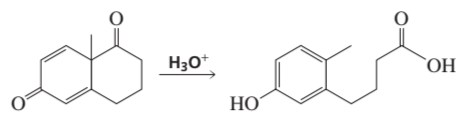
Propose a mechanism for each of the following reactions:
b. Chemical reaction diagram illustrating nucleophilic acyl substitution with reactants and products labeled.

Verified step by step guidance
1
Step 1: Analyze the starting material and the product. The starting material is a cyclic diketone, and the product is a phenol with a carboxylic acid side chain. This suggests a ring-opening reaction followed by rearrangement under acidic conditions.
Step 2: Protonation of one of the carbonyl groups occurs first under acidic conditions (H3O+), making the carbonyl carbon more electrophilic and susceptible to nucleophilic attack.
Step 3: Water acts as a nucleophile and attacks the protonated carbonyl group, leading to the formation of a tetrahedral intermediate. This intermediate undergoes rearrangement to open the ring structure.
Step 4: The ring-opening leads to the formation of a linear intermediate. Subsequent proton transfers and tautomerization occur, converting one of the ketone groups into a hydroxyl group (phenol formation).
Step 5: The other carbonyl group undergoes hydrolysis to form a carboxylic acid. The final product is stabilized by resonance in the aromatic ring and the carboxylic acid group.

Verified video answer for a similar problem:

This video solution was recommended by our tutors as helpful for the problem above.
Video duration:
3m
Was this helpful?

Key Concepts

Here are the essential concepts you must grasp in order to answer the question correctly.

Nucleophilic Acyl Substitution

Nucleophilic acyl substitution is a fundamental reaction in organic chemistry where a nucleophile attacks an acyl compound, leading to the replacement of a leaving group. In this mechanism, the nucleophile, often a water molecule in the presence of acid, attacks the carbonyl carbon, forming a tetrahedral intermediate. This intermediate then collapses, expelling the leaving group and forming a new carbonyl compound.
Recommended video:
Guided course
01:47
Nucleophiles and Electrophiles can react in Substitution Reactions.

Role of H3O+ in Acid-Catalyzed Reactions

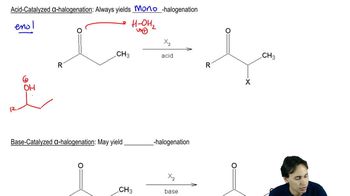
H3O+ (hydronium ion) acts as a catalyst in acid-catalyzed reactions, enhancing the electrophilicity of carbonyl compounds. In the context of nucleophilic acyl substitution, H3O+ protonates the carbonyl oxygen, increasing the positive charge on the carbonyl carbon and making it more susceptible to nucleophilic attack. This step is crucial for facilitating the reaction and ensuring a higher reaction rate.
Recommended video:
Guided course
03:09
Acid Catalyzed

Tetrahedral Intermediate

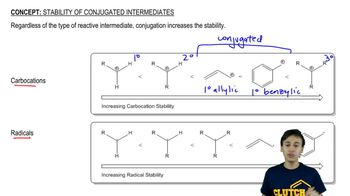
The tetrahedral intermediate is a key species formed during nucleophilic acyl substitution. When the nucleophile attacks the carbonyl carbon, the sp2 hybridization of the carbon changes to sp3, resulting in a tetrahedral geometry. This intermediate is unstable and typically collapses to reform the carbonyl group, leading to the release of the leaving group and the formation of the final product.
Recommended video:
Guided course
04:31
Stability of Conjugated Intermediates
Related Practice
Textbook Question

The following reaction is known as the benzoin condensation. The reaction does not take place if sodium hydroxide is used instead of sodium cyanide. Propose a mechanism for the reaction and explain why the reaction does not occur if hydroxide ion is the base.

1551
views
Textbook Question

A compound known as Hagemann's ester can be prepared by treating a mixture of formaldehyde and ethyl acetoacetate first with base and then with acid and heat. Write the structure for the product of each of the steps.

b. The second step is a Michael addition.

2003
views
Textbook Question

A Mannich reaction puts a -group on the α-carbon of a ketone. Propose a mechanism for the reaction.

63
views
Textbook Question

A Cannizzaro reaction is the reaction of an aldehyde that has no a-hydrogens with concentrated aqueous sodium hydroxide. In this reaction, half the aldehyde is converted to a carboxylic acid and the other half is converted to an alcohol. Propose a mechanism for the following Cannizzaro reaction:

1590
views
Textbook Question

Alkylation of the following compound with methyl iodide under two different conditions forms two different ketoesters (A and B). Each ketoester forms a cyclic diketone (C and D) when treated with methoxide ion in methanol. a. Draw the structures of A and B, and indicate the conditions used in the alkylation reaction that cause that ketoester to be formed.

1802
views
Textbook Question

A carboxylic acid is formed when an a-haloketone reacts with hydroxide ion. This reaction is called a Favorskii reaction. Propose a mechanism for the following Favorskii reaction. (Hint: In the first step, HO- removes a proton from the a-carbon that is not bonded to Br; a three-membered ring is formed in the second step; and HO- is a nucleophile in the third step.)

1340
views