Ch. 19 - More About Amines • Reactions of Heterocyclic Compounds
Bruice - Organic Chemistry 8th Edition
Bruice8th EditionOrganic ChemistryISBN: 9780135213711Not the one you use?Change textbook
Chapter 20, Problem 34

The chemical shifts of the C-2 hydrogen in the spectra of pyrrole, pyridine, and pyrrolidine are 2.82 ppm, 6.42 ppm, and 8.50 ppm. Match each heterocycle with its chemical shift.

Verified step by step guidance
1
Understand the problem: The task is to match the given chemical shifts (2.82 ppm, 6.42 ppm, and 8.50 ppm) to the correct heterocyclic compounds (pyrrole, pyridine, and pyrrolidine) based on their electronic environments and aromaticity.
Step 1: Recall the structure and properties of each heterocycle. Pyrrole is an aromatic five-membered ring with a nitrogen atom contributing a lone pair to the aromatic π-system. Pyridine is an aromatic six-membered ring with a nitrogen atom that does not contribute its lone pair to the π-system. Pyrrolidine is a non-aromatic five-membered ring with a nitrogen atom in an sp³ hybridized state.
Step 2: Analyze the chemical shift trends. In general, aromatic protons experience deshielding due to the ring current effect, leading to higher chemical shifts. Non-aromatic systems, like pyrrolidine, typically have lower chemical shifts due to the absence of this effect.
Step 3: Match the chemical shifts to the heterocycles. The lowest chemical shift (2.82 ppm) corresponds to pyrrolidine, as it is non-aromatic and has less deshielding. The intermediate chemical shift (6.42 ppm) corresponds to pyrrole, which is aromatic but has a less electronegative nitrogen atom. The highest chemical shift (8.50 ppm) corresponds to pyridine, as its nitrogen atom is more electronegative and contributes to greater deshielding.
Step 4: Verify the reasoning by considering the electronic environments of the C-2 hydrogens in each compound. Pyrrolidine's C-2 hydrogen is in a relatively shielded environment, pyrrole's C-2 hydrogen is in an aromatic environment with moderate deshielding, and pyridine's C-2 hydrogen is in an aromatic environment with significant deshielding due to the electronegative nitrogen atom.

Verified video answer for a similar problem:

This video solution was recommended by our tutors as helpful for the problem above.
Video duration:
5m
Was this helpful?

Key Concepts

Here are the essential concepts you must grasp in order to answer the question correctly.

Chemical Shift

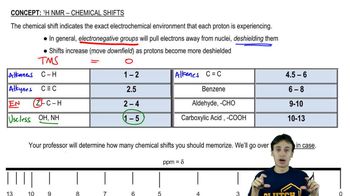
Chemical shift is a key concept in nuclear magnetic resonance (NMR) spectroscopy that indicates the resonance frequency of a nucleus relative to a standard reference frequency. It is measured in parts per million (ppm) and provides insight into the electronic environment surrounding the nucleus. Different functional groups and molecular structures influence the chemical shift, allowing chemists to deduce structural information about the compound.
Recommended video:
Guided course
11:44
1H NMR Chemical Shifts

Heterocycles

Heterocycles are cyclic compounds that contain at least one atom other than carbon in the ring, such as nitrogen, oxygen, or sulfur. Common examples include pyrrole, pyridine, and pyrrolidine, each exhibiting distinct chemical properties and reactivities due to their unique electronic structures. Understanding the nature of these heterocycles is essential for interpreting their NMR spectra and predicting their chemical shifts.
Recommended video:
2:06
Nomenclature of Heterocycles Concept 1

Electronegative Atoms and Their Effects

Electronegative atoms, such as nitrogen in heterocycles, significantly affect the electron density around hydrogen atoms, influencing their chemical shifts in NMR spectroscopy. In pyridine, the nitrogen atom withdraws electron density, resulting in a higher chemical shift for the C-2 hydrogen compared to pyrrole, where the nitrogen is part of a conjugated system. Recognizing these effects is crucial for accurately matching chemical shifts to the corresponding heterocycles.
Recommended video:
Guided course
1:47
Electronegativity